MCQ
Which of the following statement must always be true?
  1. If an objects acceleration is zero, then its speed must remain constant.
  2. If an objects acceleration is constant, then it must move in a straight line. 
  3. If an objects speed remains constant, then its acceleration must be zero.
  • A
    I and III only
  • B
    I only
  • C
    III only
  • D
    II and II only

Answer

  1. I only

Explanation:

Acceleration is the rate of change of speed of the object. Thus when acceleration is zero, the speed of object remains constant.

Acceleration of an object moving in a circular path is $\frac{\text{v}^2}{\text{R}}.$ Thus an object with constant acceleration may not move in a straight line.

Again in case of circular path, the speed remains same, but acceleration is finite.

Need a full question paper?

Generate a complete, print-ready paper with questions like this in minutes — across 16+ boards, with answer keys.

Start Generating Free

Similar questions

A stationary source is emitting sound at a fixed frequency $\mathrm{f}_0$, which is reflected by two cars approaching the source. The difference between the frequencies of sound reflected from the cars is $1.2 \%$ of $f_0$. What is the difference in the speeds of the cars (in $\mathrm{km}$ per hour) to the nearest integer? The cars are moving at constant speeds much smaller than the speed of sound which is $330 \mathrm{~ms}^{-1}$.
A $6000 \,kg$ rocket is set for firing. If the exhaust speed is $1000 \,m / s$, how much gas must be ejected each second to supply the thrust needed to overcome the weight of the rocket is .......... $kg$
Two projectiles A and B thrown with speeds in the ratio $1:\sqrt{2}$ acquired the same height. If A is thrown at an angle of 45° with the horizontal, then angle of projection of B will be:
In the reported figure, two bodies $A$ and $B$ of masses $200\, {g}$ and $800\, {g}$ are attached with the system of springs. Springs are kept in a stretched position with some extension when the system is released. The horizontal surface is assumed to be frictionless. The angular frequency will be $.....\,{rad} / {s}$ when ${k}=20 \,{N} / {m} .$
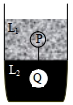
Two spheres $P$ and $Q$ of equal radii have densities $\rho_1$ and $\rho_2$, respectively. The spheres are connected by a massless string and placed in liquids $L_1$ and $L_2$ of densities $\sigma_1$ and $\sigma_2$ and viscosities $\eta_1$ and $\eta_2$, respectively. They float in equilibrium with the sphere $P$ in $L_1$ and sphere $Q$ in $L _2$ and the string being taut (see figure). If sphere $P$ alone in $L _2$ has terminal velocity $\overrightarrow{ V }_{ P }$ and $Q$ alone in $L _1$ has terminal velocity $\overrightarrow{ V }_{ Q }$, then

$(A)$ $\frac{\left|\overrightarrow{ V }_{ P }\right|}{\left|\overrightarrow{ V }_{ Q }\right|}=\frac{\eta_1}{\eta_2}$ $(B)$ $\frac{\left|\overrightarrow{ V }_{ P }\right|}{\left|\overrightarrow{ V }_{ Q }\right|}=\frac{\eta_2}{\eta_1}$

$(C)$ $\overrightarrow{ V }_{ P } \cdot \overrightarrow{ V }_{ Q } > 0$ $(D)$ $\overrightarrow{ V }_{ P } \cdot \overrightarrow{ V }_{ Q } < 0$

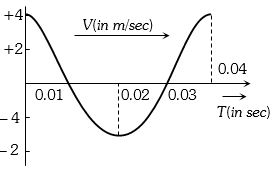
The velocity-time diagram of a harmonic oscillator is shown in the adjoining figure. The frequency of oscillation is ..... $Hz$
A body moving towards a finite body at rest collides with it. It is possible that:
  1. Both the bodies come to rest.
  2. Both the bodies move after collision.
  3. The moving body comes to rest and the stationary body starts moving.
  4. The stationary body remains stationary, the moving body changes its velocity.
The two interfering waves have intensities in the ratio $9 : 4$. The ratio of intensities of maxima and minima in the interference pattern will be
Newton-second is the unit of
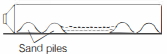
A closed pipe of length $300 \,cm$ contains some sand. A speaker is connected at one of its ends. The frequency of the speaker at which the sand will arrange itself in $20$ equidistant piles is close to .......... $kHz$ (velocity of sound is $300 \,m / s )$