MCQ
Which of the following statements is not true
  • A
    The coefficient of friction between two surfaces increases as the surface in contact are made rough
  • B
    The force of friction acts in a direction opposite to the applied force
  • Rolling friction is greater than sliding friction
  • D
    The coefficient of friction between wood and wood is less than 1
Answer

Correct option: C.
Rolling friction is greater than sliding friction
c
(c)Sliding friction is greater than rolling friction.

Need a full question paper?

Generate a complete, print-ready paper with questions like this in minutes — across 16+ boards, with answer keys.

Start Generating Free

Similar questions

A particle moves in east direction with $15 \,m/sec$. for $2\, sec$ then moves northward with $5\, m/sec$. for  $8 \,sec$. then average velocity of the particle is  
Pressure head in Bernoulli's equation is
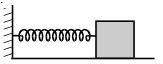
$A$ spring block system is placed on a rough horizontal floor. The block is pulled towards right to give spring an elongation less than $\frac{{2\mu mg}}{K}$ but more than $\frac{{\mu mg}}{K}$ and released.The correct statement is
$Assertion :$ Two waves moving in a uniform string having uniform tension cannot have different velocities.
$Reason :$ Elastic and inertial properties of string are same for all waves in same string. Moreover speed of wave in a string depends on its elastic and inertial properties only.
The wavelength of a particle is $99 cm$ and that of other is $100 cm$ Speed of sound is $396 m/s$. The number of beats heard is
A particle of mass $m$ travelling along $x-$ axis with speed $v_0$ shoots out $1/3^{rd}$ of its mass with a speed $2v_0$ along $y-$ axis. The velocity of remaining piece is
A wave travelling in positive $x-$direction with $A = 0.2\;m$ has a velocity of $360 \;m/sec.$ if $\lambda = 60\;m,$ then correct expression for the wave is
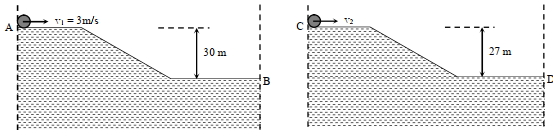
Two identical uniform discs roll without slipping on two different surfaces $AB$ and $CD$ (see figure) starting at $A$ and $C$ with linear speeds $v _1$ and $v _2$, respectively, and always remain in contact with the surfaces. If they reach $B$ and $D$ with the same linear speed and $v_1=3 \ m / s$, then $v_2$ in $m / s$ is $\left(g=10 \ m / s ^2\right)$
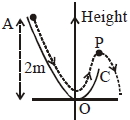
A particle $(\mathrm{m}=1\; \mathrm{kg})$ slides down a frictionless track $(AOC)$ starting from rest at a point $A$ (height $2\; \mathrm{m}$ ). After reaching $\mathrm{C}$, the particle continues to move freely in air as a projectile. When it reaching its highest point $P$ (height $1 \;\mathrm{m}$ ). the kinetic energy of the particle (in $\mathrm{J}$ ) is : (Figure drawn is schematic and not to scale; take $\left.g=10 \;\mathrm{ms}^{-2}\right)$
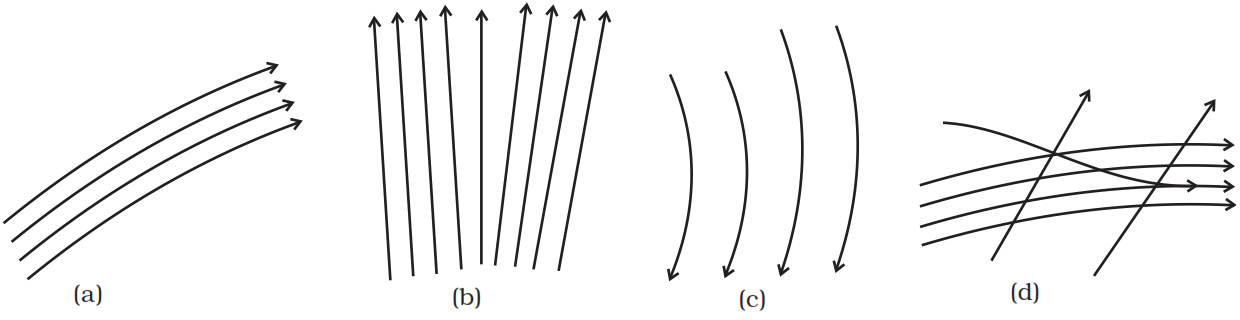
Which of the following diagrams does not represent a streamline flow?