MCQ
Which of the property makes difference between progressive and stationary waves
  • A
    Amplitude
  • B
    Frequency
  • Propagation of energy
  • D
    Phase of the wave

Answer

Correct option: C.
Propagation of energy
(c) Progressive wave propagate energy while no propagation of energy takes place instationary waves.

Need a full question paper?

Generate a complete, print-ready paper with questions like this in minutes — across 16+ boards, with answer keys.
Start Generating Free

Similar questions

The focal length of an objective of a telescope is $3$ metre and diameter $15 \mathrm{~cm}$. Assuming for a normal eye, the diameter of the pupil is $3 \mathrm{~mm}$ for its complete use, the focal length of eye piece must be
The kinetic energy and potential energy of a particle executing simple harmonic motion will be equal, when displacement (amplitude $=a$ ) is
If $\lambda_v, \lambda_r$ and $\lambda_m$ represent the wavelength of visible light $x-$rays and microwaves respectively, then
By a monochromatic wave, we mean
A uniform magnetic field of $2 \times 10^{-3} \mathrm{~T}$ acts along positive $\mathrm{Y}$-direction. A rectangular loop of sides $20$ $\mathrm{cm}$ and $10 \mathrm{~cm}$ with current of $5 \mathrm{~A}$ is $\mathrm{Y}-\mathrm{Z}$ plane. The current is in anticlockwise sense with reference to negative $\mathrm{X}$ axis. Magnitude and direction of the torque is :
Two simple pendulums whose lengths are $100 \ cm$ and $121 \ cm$ are suspended side by side. Their bobs are pulled together and then released. After how many minimum oscillations of the longer pendulum, will the two be in phase again
If the length of the simple pendulum is increased by $44 \%$, then what is the change in time period of pendulum
The angular velocity of rotation of star (of mass $M$ and radius $R$ ) at which the matter start to escape from its equator will be
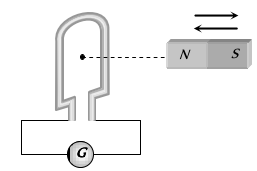
When a magnet is pushed in and out of circular coil $C$ connected to a very sensitive galvanometer $G$ as shown in the adjoining diagram with a frequency $v$, then
Image
A particle free to move along the $x$-axis has potential energy given by $U(x)=k\left[1-\exp (-x)^2\right]$ for $-\infty \leq x \leq+\infty$, where $k$ is a positive constant of appropriate dimensions. Then