Question
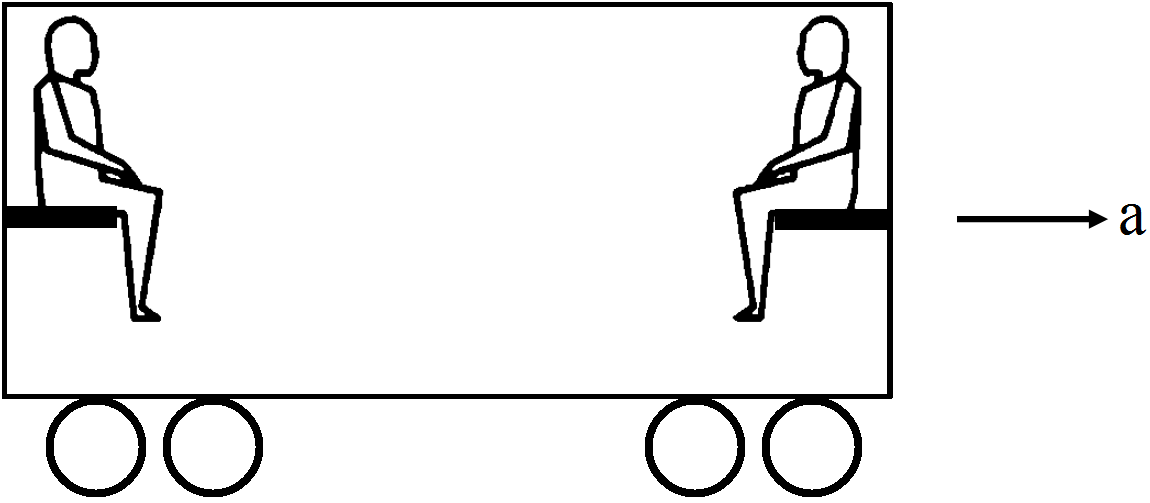
Which of the two persons shown in figure is more likely to fall down? Which external force is responsible for his falling down?
100%

Answer

The person sitting on right side of the figure is likely to fall Because of moment of inertia of the body of person his upper body is still in rest but lower body that is in contact with seat due to friction may move forward (right) as center of mass may be at the center of body the man may fall towards left.

Need a full question paper?

Generate a complete, print-ready paper with questions like this in minutes — across 16+ boards, with answer keys.

Start Generating Free

Similar questions

When are two objects just resolved? Explain. How can the resolving power of a compound microscope be increased? Use relevant formula to support your answer.
Let I = current through a conductor, R = its resistance and V = potential difference across its ends. According to Ohm's law, product of two of these quantities equals the third. Obtain Ohm's law from dimensional analysis. Dimensional formulae for R and V are $\text{ML}^2\text{I}^{-2}\text{T}^{-3}$ and $\text{ML}^2\text{T}^{-3}\text{I}^{-1}$ respectively.
The contact angle between water and glass is $0^\circ$. When water is poured in a glass to the maximum of its capacity, the water surface is convex upward. The angle of contact in such a situation is more than $90^\circ$. Explain.
An ordinary electric fan does not cool the air, still it gives comfort in summer. Explain.
Find the cutoff wavelength for the continuous X-rays coming from an X-ray tube operating at 30kV.
Define equipotential surface. Write its characteristics.
A plane electromagnetic wave is propagating along Y -axis in vacuum. Write about the (i) ratio of magnitudes and (ii) directions of electric and magnetic fields.
Why is the orientation of the portable radio with respect to broadcasting station important?
Draw the energy band diagram of (i) n-type, and (ii) p-type semiconductors at temperature T > 0 K. In the case of n-type Si-semiconductor, the donor energy level is slightly below the bottom of conduction band whereas in p-type semiconductor, the acceptor energy level is slightly above the top of valence band. Explain, giving examples, what role do these energy levels play in conduction and valence bands.
You are facing a circular wire carrying an electric current. The current is clockwise as seen by you. Is the field at the centre coming towards you or going away from you?