MCQ
Which of them are Non $-$ biodegradable waste?
  • A
    Synthetic fibers.
  • B
    Pen refills.
  • C
    Silver foil.
  • All of above.

Answer

Correct option: D.
All of above.
The waste materials which cannot be broken down into non $-$ poisonous or harmless substances in nature are called non $-$ biodegradable waste.
Examples are plastics, polythene bags, ball $-$ point pen refills, synthetic fibres, and glass objects, metal articles like aluminium cans, iron nails, silver foil and radioactive wastes.

Need a full question paper?

Generate a complete, print-ready paper with questions like this in minutes — across 16+ boards, with answer keys.
Start Generating Free

Similar questions

One mole of an ideal gas is expanded isothermally and reversibly to half of its initial pressure. $\Delta S$ for the process in $J\, K^{- 1}\, mol^{- 1}$ is $[ln\, 2\, = 0.693$ and $R\, = 8.314,\, J/(mol\, K)]$
Tautomerism take place in :-
Which of the following has the smallest number of molecules
In the chemical reaction between stoichiometric quantities of $KMnO _4$ and $KI$ in weakly basic solution, what is the number of moles of $I _2$ released for $4$ moles of $KMnO _4$ consumed ?
What is the main reason of diagonal relationship between lithium and magnesium?
In Victor Mayer’s method $0.2\, gm$ of an organic substance displaced $56 \,ml$ of air at $STP$ the molecular weight of the compound
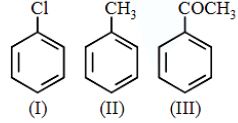
The increasing order of the reactivity of the following compounds towards electrophilic aromatic substitution reaction is
Consider a helium $( He )$ atom that absorbs a photon of wavelength $330 nm$. The change in the velocity (in $cm s ^{-1}$ ) of He atom after the photon absorption is. . . . . . 

(Assume: Momentum is conserved when photon is absorbed. Use: Planck constant $=6.6 \times 10^{-34} J s$, Avogadro number $=6 \times 10^{23} mol ^{-1}$, Molar mass of $He =4 g mol ^{-1}$ )

Match the items in Column $I$ with its main use listed in Column $II$
Column $I$ Column $II$
$(A)$ Silica gel $(i)$ Transistor
$(B)$ Silicon $(ii)$ Ion-exchanger
$(C)$ Silicone $(iii)$ Drying agent
$(D)$ Silicate $(iv)$ Sealant
In the reaction for the transition of carbon in the diamond form to carbon in the graphite form, $\Delta H$ is $ - 453.5\,cal$. This points out that