MCQ
Which of these do not form Grignard reagent
  • $C{H_3}F$
  • B
    $C{H_3}Cl$
  • C
    $C{H_3}Br$
  • D
    $C{H_3}I$

Answer

Correct option: A.
$C{H_3}F$
a
(a)The  $C-F$  bond energy is maximum in $C{H_3}F$.

Thus fluoride is the less reactive to form the grignard reagent with $Mg.$

Need a full question paper?

Generate a complete, print-ready paper with questions like this in minutes — across 16+ boards, with answer keys.

Start Generating Free

Similar questions

$9.8\,g$ of ${H_2}S{O_4}$ is present in $ 2 \,litres$ of a solution. The molarity of the solution is ....... $M$ 
The $IR$ stretchin frequencies of free $CO,$ and $CO$ in $[V(CO)_6]^-, [Cr(CO)_6]^-$ and $[Mn(CO)_6]^-$ are $2143\,cm^{-1} , 1860\,cm^{-1} , 2000 \,cm^{-1}$ and $2090 \,cm^{-1}$ , respectively. Then correct statement about metal  carbonyls is
$(NH_4 )_2Cr _2O_7$ on heating liberates a gas. The same gas will be obtained by
Among $\mathrm{VO}_2^{+}, \mathrm{MnO}_4^{-}$and $\mathrm{Cr}_2 \mathrm{O}_7^{2-}$, the spin-only magnetic moment value of the species with least oxidising ability is...................$BM$ (Nearest integer).

(Given atomic member $\mathrm{V}=23, \mathrm{Mn}=25, \mathrm{Cr}=24$ )
For the reaction $2NO_2 + F_2 \to  2NO_2F$, following mechanism has been provided :
$N{O_2} + {F_2}\xrightarrow{{slow}}N{O_2}F + F$
$N{O_2} + {F_2}\xrightarrow{{fast}}N{O_2}F$
Thus rate expression of the above reaction can be written as
Order of decreasing basic strengths of halides is
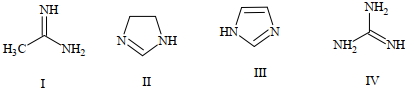
The order of basicity among the following compound is
Consider the half-cell reduction reaction

$Mn^{2+} + 2e^- \rightarrow Mn,\, $$E^o = - 1.18\, V$

$Mn^{2+} \rightarrow  Mn^{3+} + e^-,$ $ E^o = - 1.51 \,V$

The $E^o$ for the reaction $3Mn^{2+} \rightarrow  Mn^o + 2Mn^{3+},$

and possibility of the forward reaction are respectively

Zone refining is based on the principle that ___________.
Which of the following is most reactive towards nucleophilic substitution reaction ?