MCQ
Which one is not the correct statement
  • A
    $1\,volt \times 1\,coulomb = 1\,joule$
  • B
    $1\,volt \times 1\,ampere = 1\,joule/second$
  • $1\,volt \times 1\,watt = 1\,H.P.$
  • D
    Watt-hour can be expressed in $eV$

Answer

Correct option: C.
$1\,volt \times 1\,watt = 1\,H.P.$
c
(c) Because $1\, H.P. = 746\, J/s$ $=$ $746\, watt$

Need a full question paper?

Generate a complete, print-ready paper with questions like this in minutes — across 16+ boards, with answer keys.
Start Generating Free

Similar questions

For moving ball of cricket, the correct statement about de-Broglie wavelength is
Identify the material which is suitable for making standard resistors.
The focal lengths of the lenses of an astronomical telescope are $50\, cm$ and $5 \,cm.$ The length of the telescope when the image is formed at the least distance of distinct vision is
Two identical metal plates show photoelectric effect by a light of wavelength ${\lambda _A}$ falls on plate $A$ and ${\lambda _B}$ on plate $B$ $({\lambda _A} = 2{\lambda _B})$. The maximum kinetic energy is
What should be the angle between two plane mirrors so that whatever be the angle of incidence, the incident ray and the reflected ray from the two mirrors be parallel to each other.....$^o$
The time constant of a circuit is $10\, sec$, when a resistance of $10\, \Omega$ is  connected in series in a previous circuit then time constant becomes $2$ $second$ , then the  self inductance of the circuit is.....$H$
If only 2% of the main current is to be passed through a galvanometer of resistance G, then the resistance of shunt will be
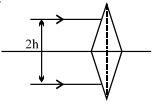
Two identical thin isosceles prisms of refracting angle $‘A’$ and refractive index $\mu$ are placed with their bases touching each other. Two parallel rays of light are incident on this system as shown. The distance of the point where the rays converge from the prism is :
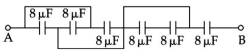
The equivalent capacitance between points $A$ and $B$ in below shown figure will be..........$\mu F$.
When a current in a circular loop is equivalently replaced by a magnetic dipole: