MCQ
Which one is paramagnetic from the following
  • A
    $O_2^ - $
  • B
    $NO$
  • Both $(a)$ and $(b)$
  • D
    $C{N^ - }$

Answer

Correct option: C.
Both $(a)$ and $(b)$
(c) $O_2^ - \,(2 \times 8 + 1 = 17)$ has odd number of electrons and hence it is paramagnetic.

All the remaining molecules/ions, i.e.,

$C{N^ - }(6 + 7 + 1 = 14)$ diamagnetic

$NO(7 + 8 = 15)$ has odd number of electrons and hence it is paramagnetic.

Need a full question paper?

Generate a complete, print-ready paper with questions like this in minutes — across 16+ boards, with answer keys.

Start Generating Free

Similar questions

What is the debroglie wavelength of electron, in hydrogen atom, moving in an orbit having maximum magnetic quantum no. $ = +2$ $\mathop {\rm{A}}\limits^{\rm{o}} $
The volume, in $mL ,$ of $0.02\, M K _{2} Cr _{2} O _{7}$ solution required to react with $0.288\, g$ of ferrous oxalate in acidic medium is........

(Molar mass of $Fe =56\, g\, mol ^{-1}$ )
In which of the following reactions, there is no change in the valency
$\text{H}-\text{C}\equiv\text{C}-\text{H}\xrightarrow[(\text{ii})\ \text{CH}_3\text{CH}_2\text{Br}]{(\text{i})\ \text{NaNH}_2/\text{liq NH}_3}\text{X}\xrightarrow[(\text{ii})\ \text{CH}_3\text{CH}_2\text{Br}]{(\text{i})\ \text{NaNH}_2/\text{liq NH}_3}\text{Y}$
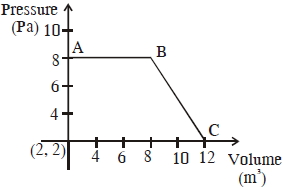
The magnitude of work done by a gas that undergoes a reversible expansion along the path $ABC$ shown in the figure is .............. $\mathrm{Joule}$
The bond energy of $C = C$ and $C -C$ at $298\, K$ are $590$ and $331\, kJ\, mol^{-1}$ respectively. The enthalpy of polymerisation per mole of ethylene is .....$ kJ$
Correct order of extent of overlapping is
The solubility of a salt $A_2B_3$ is $10^{-3}\, M$ then what will be its solubility product ?
The silicates which contain $Si_2O_7^{-6}$ units are called
To check the principle of multiple proportions, a series of pure binary compounds $\left(P_m Q_n\right)$ were analyzed and their composition is tabulated below. The correct option($s$) is(are)

Compound Weight $\%$ of $P$ Weight $\%$ of $Q$
$1$ $50$ $50$
$2$ $44.4$ $55.6$
$3$ $40$ $60$

$(A)$ If empirical formula of compound $3$ is $P_3 Q_4$, then the empirical formula of compound $2$ is $P_3 Q_5$.

$(B)$ If empirical formula of compound $3$ is $P _3 Q _2$ and atomic weight of element $P$ is $20$ , then the atomic weight of $Q$ is $45$ .

$(C)$ If empirical formula of compound $2$ is $PQ$, then the empirical formula of the compound $1$ is $P _5 Q _4$.

$(D)$ If atomic weight of $P$ and $Q$ are $70$ and $35$ , respectively, then the empirical formula of compound $1$ is $P _2 Q$.