MCQ
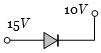
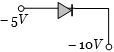
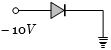
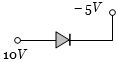
Which one is reverse-biased
  • A

  • B


  • D

Answer

Correct option: C.

c
(c)Only in option $ (c), $ $P-$ side is more negative as compared to $ N-$ side.

Need a full question paper?

Generate a complete, print-ready paper with questions like this in minutes — across 16+ boards, with answer keys.
Start Generating Free

Similar questions

Which of the following is not due to total internal reflection? 
The frequency of oscillation of current in the inductance is
In a building there are $15$ bulbs of $45\; \mathrm{W}, 15$ bulbs of $100\; \mathrm{W}, 15$ small fans of $10 \;\mathrm{W}$ and $2$ heaters of $1 \;\mathrm{kW}$. The voltage of electric main is $220\; \mathrm{V}$. The minimum fuse capacity (rated value) of the building will be: .......... $A$
A current of $0.1 A$ circulates around a coil of $100$ turns and having a radius equal to $5\ cm$. The magnetic field set up at the centre of the coil is $(m_0= 4π × 10^{-7}$ weber/amp-metre$)$
 
In an $E.M.$ wave the average energy density is associated with
The efficiency of transformer is very high because
The wavelength of the photon emitted by a hydrogen atom when an electron makes a  transition from $n =2$ to $n =1$ state is ...... $nm.$
If electric field intensity of a uniform plane electro magnetic wave is given as

$E =-301.6 \sin ( kz -\omega t ) \hat{a}_{ x }+452.4 \sin ( kz -\omega t )$ $\hat{a}_{y} \frac{V}{m}$

Then, magnetic intensity $H$ of this wave in $Am ^{-1}$ will be

[Given: Speed of light in vacuum $c =3 \times 10^{8} ms ^{-1}$, permeability of vacuum $\mu_{0}=4 \pi \times 10^{-7} NA ^{-2}$ ]

A small square loop of wire of side $\ell$ is placed inside a large square loop of wire of side $L$ $\left(\mathrm{L}=\ell^2\right)$. The loops are coplanar and therr centers coinside. The value of the mutual inductance of the system is $\sqrt{\mathrm{x}} \times 10^{-7} \mathrm{H}$, where X =___
The wavelenghts of ${K_\alpha }$ $x-$ rays of two metals $'A'$ and $'B'$ are $\frac{4}{{1875R}}$ and $\frac{1}{{675R}}$ respectively, where $'R'$ is rydberg constant. The number of elements lying between $'A'$ and $'B'$ according to their atomic numbers is