MCQ
Which one of the following is a simple harmonic motion
  • Wave moving through a string fixed at both ends
  • B
    Earth spinning about its own axis
  • C
    Ball bouncing between two rigid vertical walls
  • D
    Particle moving in a circle with uniform speed

Answer

Correct option: A.
Wave moving through a string fixed at both ends
(a) Simple harmonic waves are set up in a string fixed at the, two ends.

Need a full question paper?

Generate a complete, print-ready paper with questions like this in minutes — across 16+ boards, with answer keys.
Start Generating Free

Similar questions

The energy band gap of $S i$ is
A cell of internal resistance $1.5 \Omega$ and of e.m.f. 1.5 volt balances $500 \mathrm{~cm}$ on a potentiometer wire. If a wire of $15 \Omega$ is connected between the balance point and the cell, then the balance point will shift
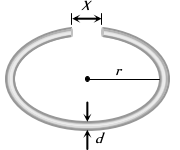
A cylindrical metal rod of length $L$ is shaped into a ring with a small gap as shown. On heating the system

Image

The gravitational force between two stones of mass $1 \mathrm{~kg}$ each separated by a distance of 1 metre in vacuum is
Consider an optical communication system operating at $\lambda 800 \mathrm{~nm}$. Suppose, only $1 \%$ of the optical source frequency is the available channel bandwidth for optical communication. How many channels can be accommodated for transmitting audio signals requiring a bandwidth of $8 \mathrm{kHz}$
Two particles of equal mass go round a circle of radius $R$ under the action of their mutual gravitational attraction. The speed of each particle is
A brass rod of cross-sectional area $1\  cm ^2$ and length $0.2 m$ is compressed lengthwise by a weight of $5 \ kg$. If Young's modulus of elasticity of brass is $1 \times 10^{11} N / m ^2$ and $g=10 m / sec ^2$, then increase in the energy of the rod will be
The vector that must be added to the vector $\hat{i}-3 \hat{j}+2 \hat{k}$ and $3 \hat{i}+6 \hat{j}-7 \hat{k}$ so that the resultant vector is a unit vector along the $y$ axis is
If water rises in a capillary tube upto $3 \mathrm{~cm}$. What is the diameter of capillary tube (Surface tension of water $=7.2 \times 10^{-2}\  \mathrm{N} / \mathrm{m}$ )
A force $\vec{F}=(5 \hat{i}+4 \hat{j})\ N$ acts on a body and produces a displacement $\vec{S}=(6 \hat{i}-5 \hat{j}+3 \hat{k}) m$. The work done will be