MCQ
Which one of the following is incorrectly matched ?
  • A
    $C_2$ epimer $\to$ Glucose and Mannose
  • B
    Anomers $\to$ $\alpha  - D - $ Glucose and $\beta  - D - $ Glucose
  • $C_2$ epimer $\to$ Glucose and Galactose
  • D
    Reducing sugar $\to$ Maltose and Lactose

Answer

Correct option: C.
$C_2$ epimer $\to$ Glucose and Galactose
c

Need a full question paper?

Generate a complete, print-ready paper with questions like this in minutes — across 16+ boards, with answer keys.

Start Generating Free

Similar questions

Compound $P$ is neutral. $Q$ gives effervescence with $NaHCO _3$ while $R$ reacts with Hinsbergs reagent to give solid soluble in $NaOH$. Compound $P$ is
In which alkyl halide, $S{N^2}$ mechanism is favoured maximum
During mixed acid nitration of benzene Conc. $HNO_3$ behaves like
Assertion : ${S_{{N^2}}}$ reactions always proceed with inversion of configuration.
Reason : ${S_{{N^2}}}$ reaction of an optically active aryl halide with an aqueous solution of $KOH$ always gives an alcohol with opposite sign of rotation.
In the following series of chemical reactions, identify  $Z $

${{C}_{3}}{{H}_{7}}OH\underset{160-{{180}\,^{o}}C}{\mathop{\xrightarrow{Conc.{{H}_{2}}S{{O}_{4}}}}}\,X\underset{{}}{\mathop{\xrightarrow{B{{r}_{2}}}}}\,Y\underset{Alc.KOH}{\mathop{\xrightarrow{\text{Excess of}}}}\,Z$

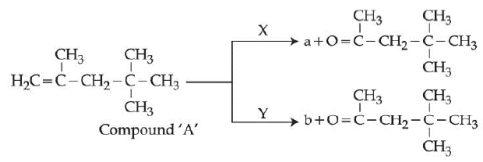
A compound '$A$' on reaction with ' $X$ ' and ' $Y$ produces the same major product but different by product '$a$' and '$b$'. Oxidation of '$a$' gives a substance produced by ants.

'$X$ ' and ' $Y$ ' respectively are :

If a chemical reaction is accompanied by the evolution of heat, it is
The rate constants $k_1$ and $k_2$ for two differentre actions are $10^{16} \cdot e^{-2000/T}$ and $ 10^{15} \cdot e^{-1000/T},$ respectively. The temperature at which $k_1 = k_2$ is
In the transition of electron in an atom, its kinetic energy changes from $y$ to $y/4$. The change in $P.E$ will be :-
The octahedral complex of a metal ion $M^{3+}$ with four monodentate ligands $L_1, L_2, L_3$ and $L_4$ absorb wave lengths in the region of red, green, yellow and blue, respectively. The increasing order of ligand strength of the four ligands is :