- ACathode rays can produce x-rays
- BThe properties of cathode rays differ from the properties of x-rays
- CThe cathode rays possess too much kinetic energy
- DCathode rays are not deflected by electric and magnetic field
Explanation:
Properties of cathode rays:
They are produced by the negative electrode, or cathode, in an evacuated tube, and travel towards the anode.
They travel in straight lines and cast sharp shadows.
They have energy and can do work.
They are deflected by electric and magnetic fields and have a negative charge.
Generate a complete, print-ready paper with questions like this in minutes — across 16+ boards, with answer keys.
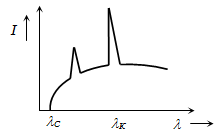
The intensity of X-rays from a Coolidge tube is plotted against wavelength as shown in the figure. The minimum wavelength found is
and the wavelength of the
line is
. As the accelerating voltage is increased

|
(a) ( |
(b) ( |
(c) |
(d) |
Three fourth of the active decays in a radioactive sample in 3/4 sec. The half life of the sample is
|
(a) |
(b) 1 sec |
(c) |
(d) |
Two similar spheres having +q and -q charge are kept at a certain distance. F force acts between the two. If in the middle of two spheres, another similar sphere having +q charge is kept, then it experience a force in magnitude and direction as
|
(a) Zero having no direction |
(b) 8F towards +q charge |
|
(c) 8F towards -q charge |
(d) 4F towards +q charge |
For the network shown in the figure the value of the current i is
|
(a) |
(b) |
(c) |
(d) |
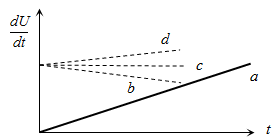
A constant current i is passed through a resistor. Taking the temperature coefficient of resistance into account, indicate which of the plots shown in figure best represents the rate of production of thermal energy in the resistor

|
(a) a |
(b) b |
(c) c |
(d) d |