MCQ
Which one of the following shows maximum paramagnetic character
  • ${\left[ {Fe{{(CN)}_6}} \right]^{3 - }}$
  • B
    ${\left[ {Fe{{(CN)}_6}} \right]^{4 - }}$
  • C
    ${\left[ {Cr{{\left( {{H_2}O} \right)}_6}} \right]^{3 + }}$
  • D
    ${\left[ {Cu{{({H_2}O)}_6}} \right]^{2 + }}$

Answer

Correct option: A.
${\left[ {Fe{{(CN)}_6}} \right]^{3 - }}$
a
(i) $\left[F e(C N)_{6}\right]^{3-}$

Here, oxidation state of $F e=+3$

Electronic configuration of $F e$ (ground state) $=[A r] 3 d^{6} 4 s^{2}$

Electronic configuration of $F e$ (excited state) $=[A r] 3 d^{5} 4 s^{0}$

Number of unpaired electrons $=5$

(ii) $\left[F e(C N)_{6}\right]^{4-}$

Here, oxidation state of $F e=+2$

Electronic configuration of $F e$ (ground state) $=[A r] 3 d^{6} 4 s^{2}$

Electronic configuration of $F e$ (excited state) $=[A r] 3 d^{6} 4 s^{0}$

Number of unpaired electrons $=4$

(iii) $\left[\operatorname{Cr}\left(H_{2} O\right)_{6}\right]^{3+}$

Here, oxidation state of $C r=+3$

Electronic configuration of $C r^{3+}=[A r] 3 d^{3} 4 s^{0}$

Number of unpaired electrons $=3$

(iv) $\left[ Cu \left( H _{2} O \right)_{6}\right]^{2+}$

Here, oxidation state of $C u=+2$

Electronic configuration of $C u^{2+}=[A r] 3 d^{9} 4 s^{0}$

Number of unpaired electrons $=1$

A number of unpaired electrons present is directly proportional to a paramagnetic character.

So, $\left[ Fe ( CN )_{6}\right]^{3-}$ has maximum paramagnetic character.
Need a full question paper?

Generate a complete, print-ready paper with questions like this in minutes — across 16+ boards, with answer keys.

Start Generating Free

Similar questions

Which of the following is non reducing sugar
The correct order of energy of absorption for the following metal complexes is

$A: \left[ Ni ( en )_{3}\right]^{2+}, B :\left[ Ni \left( NH _{3}\right)_{6}\right]^{2+}, C :\left[ Ni \left( H _{2} O \right)_{6}\right]^{2+}$

Although $+3$ is the characteristic oxidation state for lanthanoids but cerium also shows $+4$ oxidation state because $........$
$a.$ It has variable ionisation enthalpy
$b.$ It has a tendency to attain noble gas configuration
$c.$ It has a tendency to attain $f^0$ configuration
$d.$ It resembles $\mathrm{Pb}^{4+}$
$S^{2-}$ and $SO_3\,^{2-}$ can be distinguished by using
Treatment of propionaldehyde with dil. $NaOH$ gives
 $\begin{array}{*{20}{c}}
  {C{H_3} - CH - C{H_2} - C{H_3}\xrightarrow[\Delta ]{{KOH}}product} \\ 
  {|\,\,\,\,\,\,\,\,\,\,\,\,\,\,\,\,\,\,\,\,\,\,\,\,\,\,\,\,\,\,\,\,\,\,\,\,\,\,\,\,\,\,\,\,\,\,\,\,\,\,\,\,\,\,\,\,\,\,\,\,} \\ 
  {Cl\,\,\,\,\,\,\,\,\,\,\,\,\,\,\,\,\,\,\,\,\,\,\,\,\,\,\,\,\,\,\,\,\,\,\,\,\,\,\,\,\,\,\,\,\,\,\,\,\,\,\,\,\,\,\,\,\,\,\,} 
\end{array}$

Possible number of elimination products (alkene) of the given reaction is?

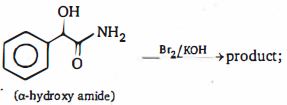
Product of this Hoffmann bromamide reaction is
“The relative lowering of the vapour pressure is equal to the mole fraction of the solute.” This law is called
Consider the reaction sequence below 

$[Figure]$   $\xrightarrow[{{\text{AlC}}{{\text{l}}_3}}]{{{\text{Succinic anhydride}}}}A\xrightarrow[{{\text{reduction}}}]{{{\text{Clemmenson 's}}}}X$ is

$1\,mol$ each of the following compounds is dissolved in $1\,L$ of solution. Which will have the largest $\Delta T_b$ value ?