MCQ
Which one the following compounds will readily react with dilute $\mathrm{NaOH}$ ?
  • A
    $\mathrm{C}_6 \mathrm{H}_5 \mathrm{CH}_2 \mathrm{OH}$
  • B
    $\mathrm{C}_2 \mathrm{H}_5 \mathrm{OH}$
  • C
    $\left(\mathrm{CH}_3\right)_3 \mathrm{COH}$
  • $\mathrm{C}_6 \mathrm{H}_5 \mathrm{OH}$

Answer

Correct option: D.
$\mathrm{C}_6 \mathrm{H}_5 \mathrm{OH}$
d
Stronger $ACID$ than $\mathrm{H}_2 \mathrm{O}$

Need a full question paper?

Generate a complete, print-ready paper with questions like this in minutes — across 16+ boards, with answer keys.

Start Generating Free

Similar questions

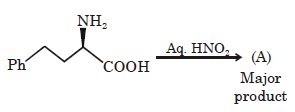
Major product of above reaction is 
At $298\, K$ find out the $emf$ for the cell ............ $\mathrm{V}$

$Al_{(s)}\, | Al^{+3}\, (0.1\,M)||Fe^{+2}\, (0.001\,M)|Fe_{(s)}$

If $E_{A{l^{ + 3}}/Al}^o =  - 1.66\,V$ and $E_{Fe/F{e^{ + 2}}}^o =  + 0.44\,V$

Among the following, the energy of $2s$ orbital is lowest in
The oxidation number of $Cr$  in $[Cr{(N{H_3})_6}]C{l_3}$ is
Which of the following compound does not give oxyacid of central atom on hydrolysis?
${H_2}(g) + \frac{1}{2}{O_2}(g)\,\, \to \,\,{H_2}O(l)$; $\Delta H$ at $ 298 \,K = -285.8\, kJ$ The molar enthalpy of vaporisation of water at $ 1 $ $atm$ and ${25\,^o}C$ is $44\, kJ. $ The standard enthalpy of formation of  $1$  mole of water vapour at ${25\,^o}C$ is.......$kJ$
$2\, g$ of hydrogen combine with $16\, g$ of oxygen to form water and with $6\, g$ of carbon to form methane. In carbon dioxide $12\, g$ of carbon are combined with $32 \,g$ of oxygen. These figures illustrate the law of
Consider the following statements

$(I)$ The radius of an anion is larger than that of the parent atom. 

$(II)$ The ionization energy generally increases with increasing atomic number  in a period.

$(III)$ The electronegativity of an element is the tendency of an isolated atom  to attract an electron.

Which of the above statements is/are correct?

The total number of $C - C$ sigma bond/s in mesityl oxide $\left( C _{6} H _{10} O \right)$ is ...... . (Round off to the Nearest Integer).
Dissolving $120\, g$ of a compound (mol. wt. $60$) in $1000\, g$ of water gave a solution of density $1.12\, g/mL$. The molarity of the solution is ............ $\mathrm{M}$