MCQ
Which ray contain positively charged particle
  • $\alpha -$ ray
  • B
    $\beta -$ ray
  • C
    $\gamma -$ ray
  • D
    $X-$ ray

Answer

Correct option: A.
$\alpha -$ ray
a
$\alpha$ - Particles are doubly charged helium nuclei. They are positively charged and gets deflected towards negatively charged plates.

$\Rightarrow He ^{2+}$

$\beta$ - particles are fast moving electrons.

$\Rightarrow e ^{-}$

$\gamma$ - rays are electromagnetic waves.

$\Rightarrow$ Em wave

$X$ - rays are electromagnetic waves.

$\Rightarrow$ Em wave.

Need a full question paper?

Generate a complete, print-ready paper with questions like this in minutes — across 16+ boards, with answer keys.
Start Generating Free

Similar questions

A convex mirror of radius of curvature $30 \mathrm{~cm}$ forms an image that is half the size of the object. The object distance is :
A particle moves on the $X-$ axis according to the equation $\text{x = A + B}\sin\omega\text{t}.$ The motion is simple harmonic with amplitude:
A galvanometer of resistance $50\, \Omega$ is connected to a battery of $3\, V$ along with a resistance of $2950\, \Omega$ in series. A full scale deflection of $30$ divisions is obtained in the galvanometer. In order to reduce this deflection to $20$ divisions, the resistance in series should be.......$Ω$
In which of the following transitions will the wavelength be minimum?
Calculate the wavelength of electromagnetic waves of frequency $300\ MHz.$
The breaking stress of a wire depends on:
A coil is wound as a transformer of rectangular cross-section. If all the linear dimensions of the transformer are increased by a factor 2 and the number of turns per unit length of the coil remain the same, the self inductance increased by a factor of
A uniform wire of resistance $50\Omega$ is cut into 5 equal parts. These parts are now connected in parallel. The equivalent resistance of the combination is:
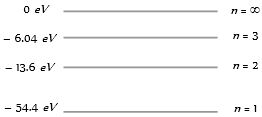
The energy level diagram for an hydrogen like atom is shown in the figure. The radius of its first Bohr orbit is
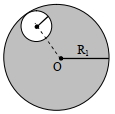
Consider a uniform spherical charge distribution of radius $R_1$ centred at the origin $O$. In this distribution, a spherical cavity of radius $R_2$, centred at $P$ with distance $O P=a=R_1-R_2$ (see figure) is made. If the electric field inside the cavity at position $\overrightarrow{ r }$ is $\overrightarrow{ E }(\overrightarrow{ r })$, then the correct statement$(s)$ is(are) $Image$