MCQ
Which reagent is used to distinguish between secondary and tertiary amines?
  • A
    Nessler reagent
  • B
    Tollens reagent
  • Hinsberg's reagent
  • D
    Schiff's reagent

Answer

Correct option: C.
Hinsberg's reagent
C

Need a full question paper?

Generate a complete, print-ready paper with questions like this in minutes — across 16+ boards, with answer keys.

Start Generating Free

Similar questions

The rate of a reaction decreased by $3.555$ times when the temperature was changed from $40^{\circ} C$ to $30^{\circ} C$. The activation energy of the reaction is.........$kJ\, mol ^{-1}$

[Take; $R =8.314 \,J\, mol ^{-1}\, K ^{-1}$ In $3.555=1.268$]

The compounds $[Cr(H_2O)_6 ]Cl_3 , [Cr(H_2O)_5Cl]Cl_2 H_2O$ and $[Cr(H_2O)_4 Cl_2]Cl_2.2H_2O$ exhibits
Complete reaction of acetaldehyde with excess formaldehyde, upon heating with conc. $NaOH$ solution, gives $P$ and $Q$. Compound $P$ does not give Tollens' test, whereas $Q$ on acidification gives positive Tollens' test. Treatment of $P$ with excess cyclohexanone in the presence of catalytic amount of $p$-toluenesulfonic acid (PTSA) gives product $R$.

Sum of the number of methylene groups $\left(- CH _2-\right.$ ) and oxygen atoms in $R$ is. . . .

The reaction is $C{H_3}CH = C{H_3}\mathop {\xrightarrow{{CO + {H_2}O}}}\limits_{{H^ + }} $  $\begin{array}{*{20}{c}}
  {C{H_3} - CH - C{H_3}} \\ 
  {|\,\,\,\,\,} \\ 
  {\,\,\,\,\,\,\,\,COOH} 
\end{array}$ known as
What are the major bonds in the tertiary structure of proteins that provide stability to the $2^{\circ}$ and $3^{\circ}$ structure?
Nitrogen is obtained when $NaN{O_2}$ reacts with
At $40\,^o C$, the vapour pressure (in torr) of methyl alcohol $(A)$ and ethyl alcohol $(B)$ solution is represented by :
$P_s = 120 X_A + 138$ ; where $X_A$ is mole fraction of methyl alcohol. The value of

$\mathop {\lim }\limits_{{X_A} \to 0} \left ( \frac{P_B^0}{X_B} \right )$ and $\mathop {\lim }\limits_{{X_B} \to 0}\left ( \frac{P_A^0}{X_A} \right )$ are

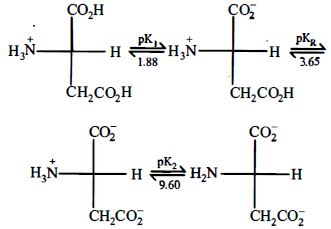
Consider the following sequence for aspartic acid

The $pI$ (isoelectric point) of aspartic acid
Which of the following haloalkanes is most reactive
Transuranic elements begin with: