MCQ
Which statement is correct
  • A
    $N-$type germanium is negatively charged and $P-$type germanium is positively charged
  • Both $N-$type and $P-$type germanium are neutral
  • C
    $N-$type germanium is positively charged and $P-$type germanium is negatively charged
  • D
    Both $N-$type and $P-$type germanium are negatively charged
Answer

Correct option: B.
Both $N-$type and $P-$type germanium are neutral
b
(b) P and N-type semiconductors are neutral because neutral atoms are added during doping.

Need a full question paper?

Generate a complete, print-ready paper with questions like this in minutes — across 16+ boards, with answer keys.

Start Generating Free

Similar questions

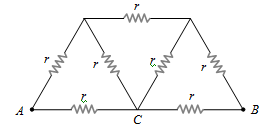
In the circuit shown, the value of each resistance is r, then equivalent resistance of circuit between points A and B will be
When reflected light of intensity $I_0$ is incident on a polarizing sheet then the intensity of that light, which does not transmit is :
A Rowland ring of mean radius $15\; cm\;3500$ turns of wire wound on a ferromagnetic core of relative permeability $800.$ What is the magnetic field $B$ (in $T$) in the core for a magnetizing current of $1.2\; A?$
A concave mirror of focal length $15\, cm$ forms an image having twice the linear dimensions of the object. The position of the object when the image is virtual will be........$cm$
When cells are connected in parallel, then
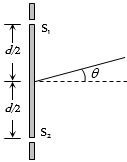
In an interference arrangement similar to Young's double slit experiment, the slits $S_1$ and $S_2$ are illuminated with coherent microwave sources each of frequency $10^6 Hz$. The sources are synchronized to have zero phase difference. The slits are separated by distance $d = 150\, m$. The intensity I$(\theta )$is measured as a function of $\theta$, where $\theta$ is defined as shown. If $I_0$ is maximum intensity, then $I(\theta )$ for $0 \le \theta \le {90^o}$is given by
A steady current $i$ flows in a small square loop of wire of side $L$ in a horizontal plane. The loop is now folded about its middle such that half of it lies in a vertical plane. Let $\overrightarrow {{\mu _1}} $ and $\overrightarrow {{\mu _2}} $ respectively denote the magnetic moments due to the current loop before and after folding. Then
Material A has critical angle ${i_A},$ and material $B$ has critical angle ${i_B}({i_B} > {i_A}).$ Then which of the following is true

$(i)$ Light can be totally internally reflected when it passes from $B$ to $A$

$(ii)$ Light can be totally internally reflected when it passes from $A$ to $B$

$(iii)$ Critical angle for total internal reflection is ${i_B} - {i_A}$

$(iv)$ Critical angle between $A$ and $B$ is ${\sin ^{ - 1}}\left( {\frac{{\sin {i_A}}}{{\sin {i_B}}}} \right)$

A conducting rod of length $l$ and mass $m$ is moving down a smooth inclined plane of inclination $\theta$ with constant velocity $v$. A current i is flowing in the conductor in a direction perpendicular to paper inward. A vertically upward magnetic field $B$ exists in space. Then, magnitude of magnetic field $B$ is:
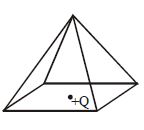
A point charge $+Q$ is positioned at the centre of the base of a square pyramid as shown. The flux through one of the four identical upper faces of the pyramid is