MCQ
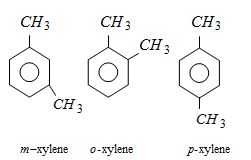
Which xylene is most easily sulphonated
- AOrtho
- BPara
- ✓Meta
- DAll at the same rate
Generate a complete, print-ready paper with questions like this in minutes — across 16+ boards, with answer keys.
$Image$
$\mathrm{x}=$ . . . . . . . . . (Nearest integer)
Given : $\left(\mathrm{K}_{\mathrm{r}}\right)_{\text {water }}=1.86 \mathrm{~K} \mathrm{~kg} \mathrm{~mol}^{-1}$.
density of acetic acid is $1.2 \mathrm{~g} \mathrm{~mol}^{-1}$
molar mass of water $=18 \mathrm{~g} \mathrm{~mol}^{-1}$.
molar mass of acetic acid $=60 \mathrm{~g} \mathrm{~mol}^{-1}$.
density of water $=1 \mathrm{~g} \mathrm{~cm}^{-3}$
Acetic acid dissociates as
$\mathrm{CH}_3 \mathrm{COOH} \rightleftharpoons \mathrm{CH}_3 \mathrm{COO}^{\oplus}+\mathrm{H}^{\oplus}$
| LIST $I$ (Technique) | LIST $II$ (Application) |
| $A$. Distillation | $I$. Separation of glycerol from spent-lye |
| $B$. Fractional distillation | $II$Aniline - Water mixture |
| $C$. Steam distillation | $III$Separation of crude oil fractions |
| $D$. Distillation under reduced pressure | $IV$.ChloroformAniline |
Choose the correct answer from the options given below: