Question
While doing an experiment with potentiometer (Fig.) it was found that the deflection is one sided and (i) the deflection decreased while moving from one end A of the wire to the end B; (ii) the deflection increased. while the jockey was moved towards the end B.
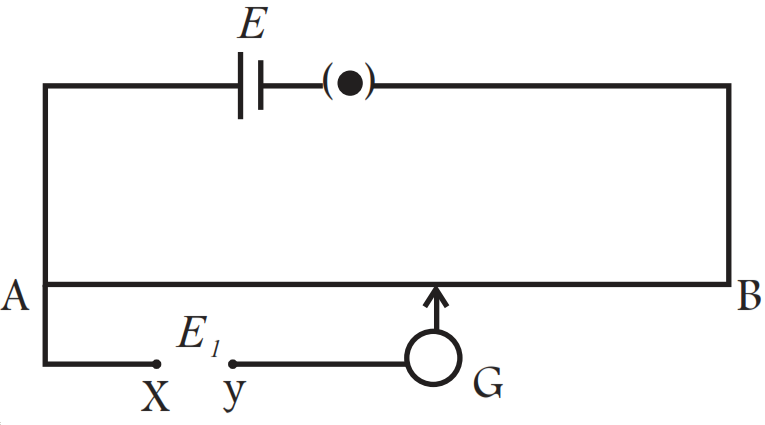
  1. Which terminal +or -ve of the cell $E_1,$ is connected at X in case (i) and how is $E_1$ related to E?
  2. Which terminal of the cell $E_1$ is connected at X in case (ii)?
Answer

  1. If the current in auxiliary circuit (lower circuit containing primary cell) decreases, and potential difference across A and jockey/increases. Then deflection in galvanometer is one sided and the deflection decreased, while moving from one end 'A' of the wire to the end 'S'. And clearly this is possible only when positive terminal of the cell $E_1$ is connected at X and $E_1 > E.$
  2. If the current in auxiliary circuit increases, and potential difference across A and jockey J increases. Then also deflection in galvanometer is one sided. And this is possible only when negative terminal of the cell $E_1$ is connected at X.

Need a full question paper?

Generate a complete, print-ready paper with questions like this in minutes — across 16+ boards, with answer keys.

Start Generating Free

Similar questions

$a$. Derive an expression for the impedance of a series $L-C-R$ circuit connected to an $AC$ supply of variable frequency.
$b$. Explain briefly how the phenomenon of resonance in the circuit can be used in the tuning mechanism of a radio or a $TV$ set?

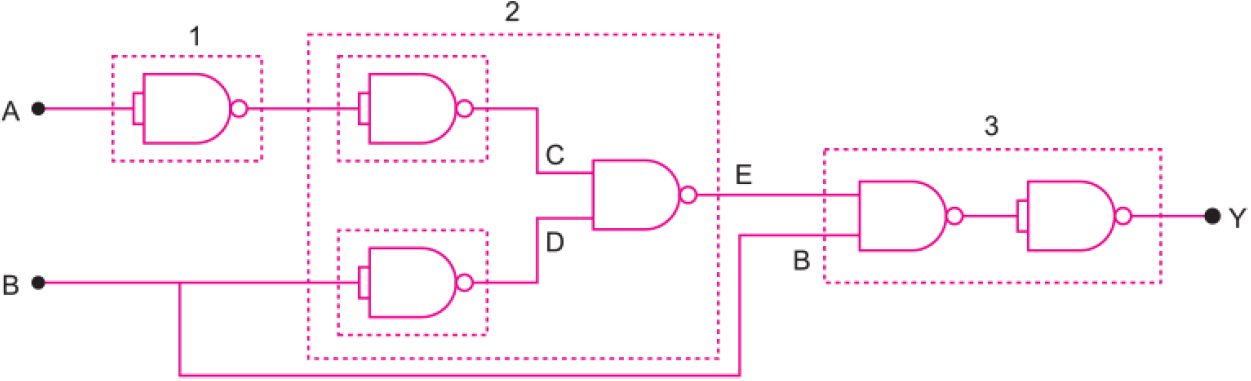
Identify which logic gate OR, AND and NOT is represented by the circuits in the dotted line boxes 1, 2 and 3. Give the truth table for the entire circuit for all possible values of A and B.
A particle A having a charge of $2.0 \times 10^{-6}C$ is held fixed on a horizontal table. A second charged particle of mass 80g stays in equilibrium on the table at a distance of 10cm from the first charge. The coefficient of friction between the table and this second particle is $\mu=0.2.$ Find the range within which the charge of this second particle may lie.
Answer the following question:
Optical and radiotelescopes are built on the ground but X - ray astronomy is possible only from satellites orbiting the earth. Why?
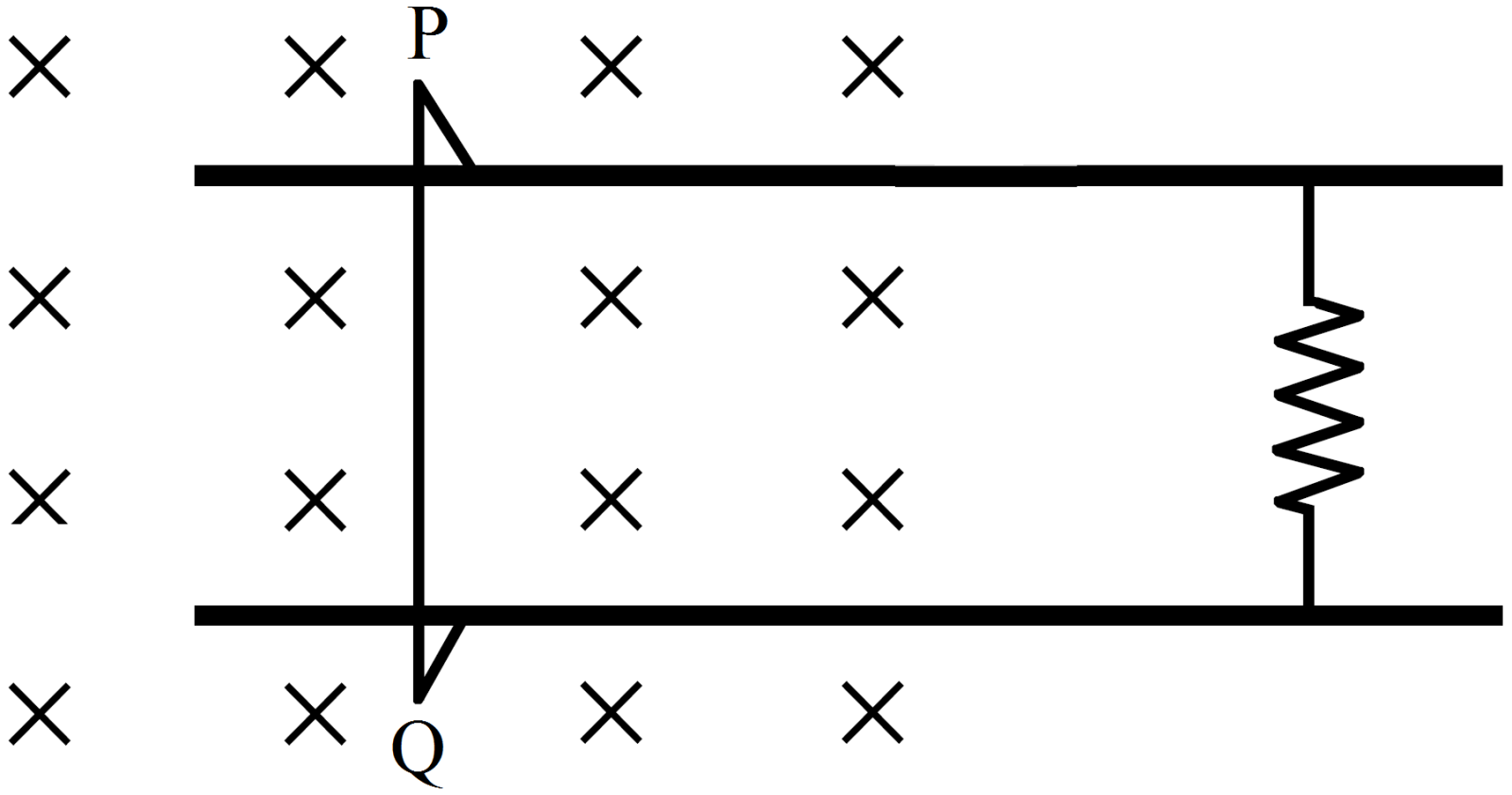
Consider the situation shown in figure. The wire PQ has mass m, resistance r and can slide on the smooth, horizontal parallel rails separated by a distance l. The resistance of the rails is negligible. A uniform magnetic field B exists in the rectangular region and a resistance R connects the rails outside the field region. At t = 0, the wire PQ is pushed towards right with a speed $v_0$. Find
  1. The current in the loop at an instant when the speed of the wire PQ is v.
  2. The acceleration of the wire at this instant.
  3. The velocity vas a functions of x.
  4. The maximum distance the wire will move.
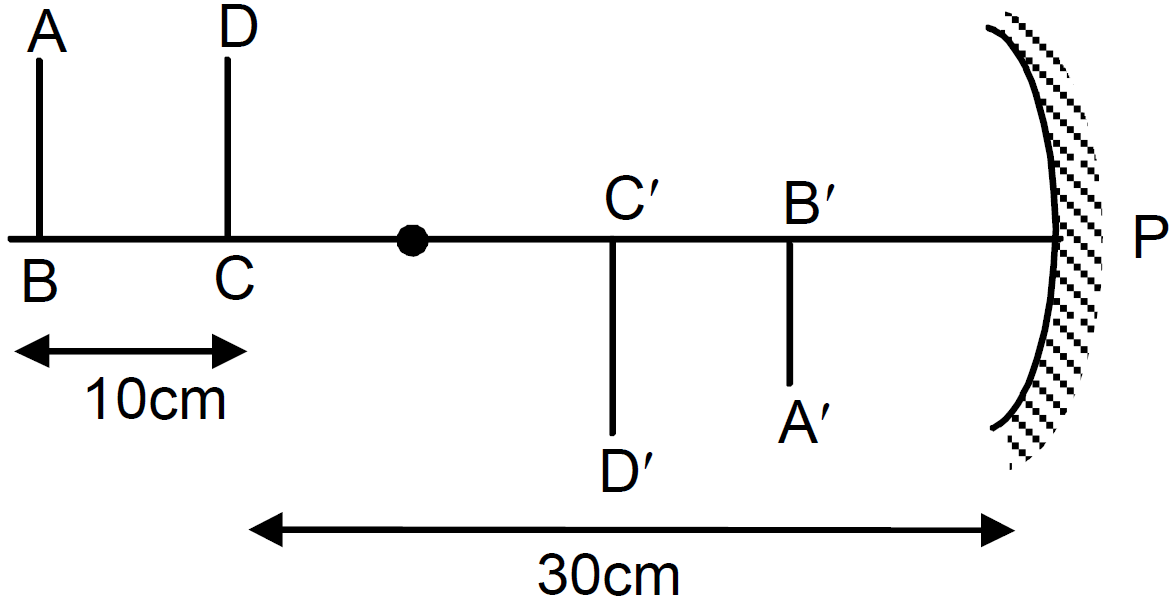
A U-shaped wire is placed before a concave mirror having radius of curvature 20cm. Find the total length of the image.
The resistance of an iron wire and a copper wire at 20°C are $3.9\Omega$ and $4.1\Omega,$ respectively. At what temperature will the resistance be equal? Temperature coefficient of resistivity for iron is $5.0\times10^{-3}\text{K}^{-1}$ and for copper, it is $4.0\times10^{-3}\text{K}^{-1}.$ Neglect any thermal expansion.
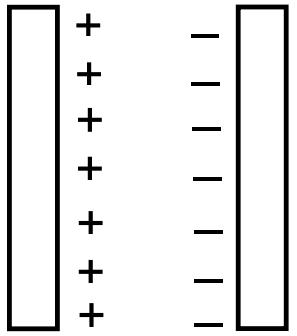
Two large conducting plates are placed parallel to each other and they carry equal and opposite charges with surface density $\sigma$ as shown in figure. Find the electric field:
  1. At the left of the plates.
  2. In between the plates.
  3. At the right of the plates.
The half-life of $^{199}Au$ is 2.7 days.
  1. Find the activity of a sample containing $1.00\mu\text{g}$ of $^{198}Au.$
  2. What will be the activity after 7 days? Take the atomic weight of $^{198}Au$ to be 198g/mol.
A thin prism of angle $6.0^\circ,\omega=0.07$ and $\mu_\text{y}=1.50$ is combined with another thin prism having $\omega=0.08$ and $\mu_\text{y}=1.60.$ The combination produces no deviation in the mean ray.
  1. Find the angle of the second prism.
  2. Find the net angular dispersion produced by the combination when a beam of white light passes through it.
  3. If the prisms are similarly directed, what will be the deviation in the mean ray
  4. Find the angular dispersion in the situation described in (c).