Question
Why does blowing over a spoonful of hot tea cools it? Does evaporation play a role? Does radiation play a role?

Answer

Here, major role is played by convection. When we blow air over a spoonful of hot tea, the air coming from our mouth has less temperature than the air above the tea. Since hot air has less density, it rises up and cool air goes down. In this way, the tea cools down.
We know that any hot body radiates.
So, the spoonful of tea will also radiate and as the temperature of the surrounding is less then the tea, the tea will cool down with time. Evaporation is also involved in this. On blowing over the hot tea, rate of evaporation increases and the cools down.
Need a full question paper?

Generate a complete, print-ready paper with questions like this in minutes — across 16+ boards, with answer keys.

Start Generating Free

Similar questions

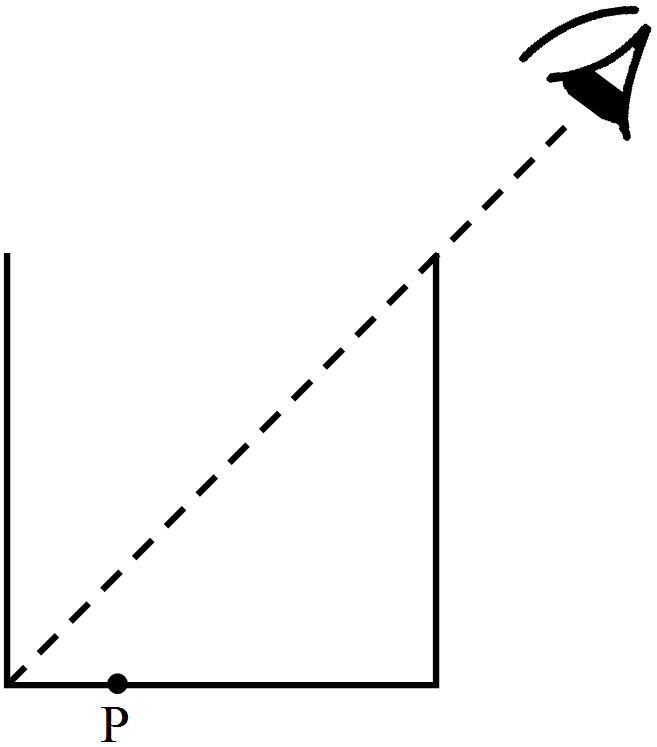
A cylindrical vessel, whose diameter and height both are equal to 30cm, is placed on a horizontal surface and a small particle P is placed in it at a distance of 5.0cm from the centre. An eye is placed at a position such that the edge of the bottom is just visible. The particle P is in the plane of drawing. Up to what minimum height should water be poured in the vessel to make the particle P visible?
Define induction coefficient. Explain the phenomenon of mutual inductance with the help of an experiment. Obtain an expression for mutual inductance coefficient of two solenoids and prove that $M=\sqrt{L_1 L_2}$.
Calculate the electric field in a copper wire of cross-sectional area $2.0mm^2$ carrying a current of 1A.
The resistivity of copper $=1.7\times10^{-8}\Omega\text{-m}.$
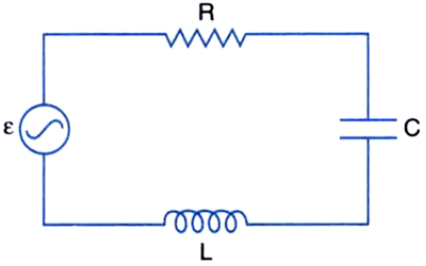
Figure shows a series LCR circuit connected to a variable frequency 230V source. L = 5.0H, C = 80μF, R = 40Ω.
  1. Determine the source frequency which drives the circuit in resonance
  2. Obtain the impedance of the circuit and the amplitude of current at the resonating frequency.
  3. Determine the rms potential drops across the three elements of the circuit. Show that the potential drop across the LC combination is zero at the resonating frequency.
The electric field associated with a light wave is given by $\text{E}=\text{E}_0\sin[(1.57\times10^7\text{m}^{-1})(\text{x}-{\text{ct}})].$ Find the stopping potential when this light is used in an experiment on photoelectric effect with the emitter having work function 1.9eV.
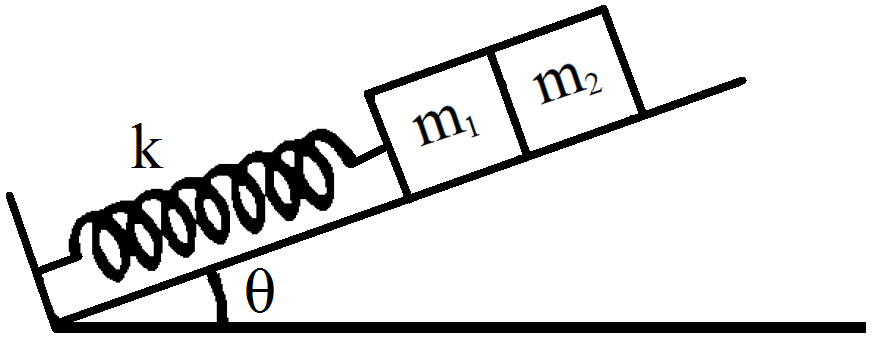
The block of mass $m_1$ shown in figure is fastened to the spring and the block of mass $m_2$ is placed against it.
  1. Find the compression of the spring in the equilibrium position.
  2. The blocks are pushed a further distance $\big(\frac{2}{\text{k}}\big)(\text{m}_1+\text{m}_2)\text{g}\sin\theta$ sine against the spring and released. Find the position where the two blocks separate.
  3. What is the common speed of blocks at the time of separation?
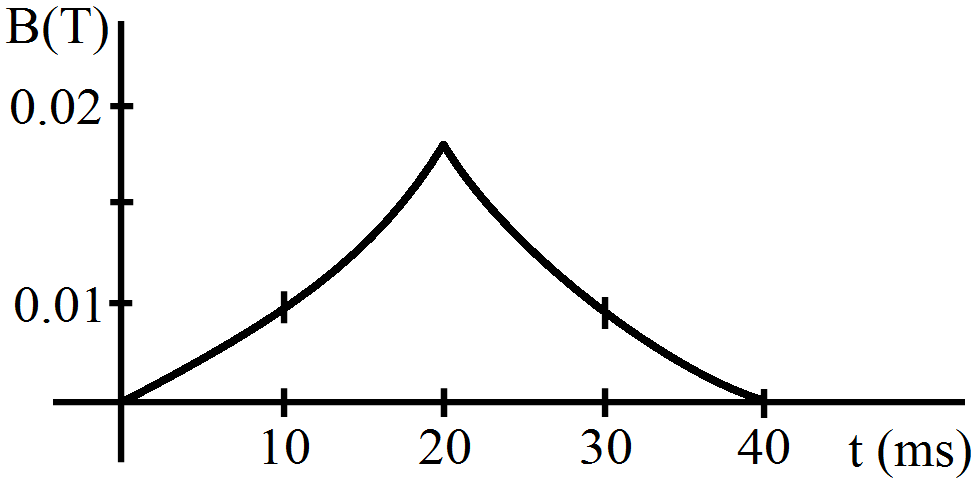
  1. The magnetic field in a region varies as shown in figure. Calculate the average induced emf in a conducting loop of area $2.0 \times 10^{-3}m^2$ placed perpendicular to the field in each of the 10ms intervals shown.
  2. In which intervals is the emf not constant? Neglect the behaviour near the ends of 10ms intervals.
The volume of a glass vessel is 1000 cc at $20^{\circ} \mathrm{C}$. What volume of mercury should be poured into it at this temperature so that the volume of the remaining space does not change with temperature? Coefficients of cubical expansion of mercury and glass are $1.8 \times 10^{-4}{ }^{\circ} \mathrm{C}$ and $9.0 \times 10^{-6}{ }^{\circ} \mathrm{C}^{-1}$ respectively.
A telephone cable at a place has four long straight horizontal wires carrying a current of 1.0 A in the same direction east to west. The earth’s magnetic field at the place is 0.39 G, and the angle of dip is 35º. The magnetic declination is nearly zero. What are the resultant magnetic fields at points 4.0 cm below the cable?
A spherical ball of mass m and radius r rolls without slipping on a rough concave surface of large radius R. It makes small oscillations about the lowest point, Find the time period.