Question
Why does fluorine not show disporportionation reaction?

Answer

In a disproportionation reaction, the same species is simultaneously oxidised as well as reduced. Therefore, for such a redox reaction to occur, the reacting species must contain an element which has adeast three oxidation states.
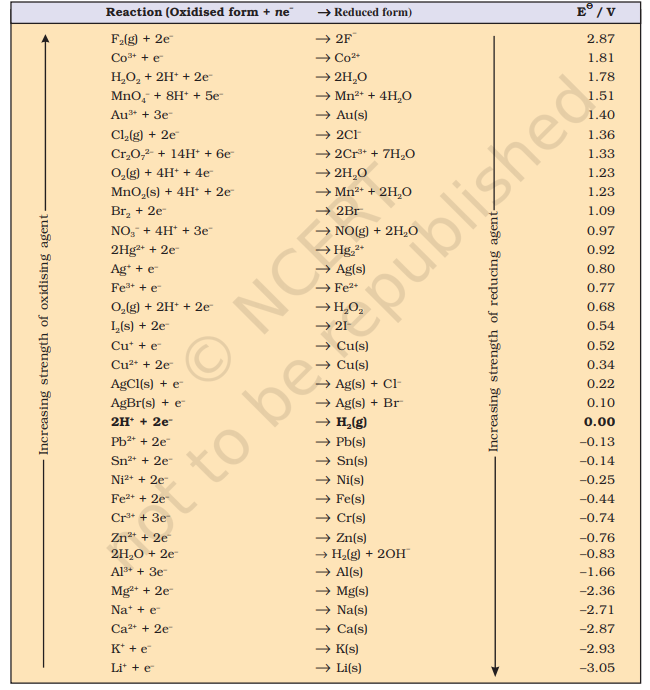
The element, in reacting species, is present in an intermediate state while lower and higher oxidation states are available for reduction and oxidation to occur (respectively). Fluorine is the strongest oxidising agent. It does not show positive oxidation state. That’s why fluorine does not show disproportionation reaction.

Need a full question paper?

Generate a complete, print-ready paper with questions like this in minutes — across 16+ boards, with answer keys.

Start Generating Free

Similar questions

What is the energy in joules, required to shift the electron of the hydrogen atom from the first Bohr orbit to the fifth Bohr orbit and what is the wavelength of the light emitted when the electron returns to the ground state? The ground state electron energy is –2.18 × 10⁻¹¹ergs.
Which of the species have similar shape and why?
$\text{NO}^-_2,\text{NO}^+_2,\text{CO}_2,\text{O}$
Account for the following:

  1. What is the state of hybridisation of stared carbon atoms in,

$\text{CH}_3-\text{}*\text{CH}=\text{CH}_2?$
  1. Write the molecular orbital electronic configuration of $\text{O}^-_2.$ Calculate its bond order and predict its magnetic behaviour.
The average molar mass of a mixture of methane (CH4) and ethane (C2H4) present in the ratio of a : b is found to be 20.0g mol-1. If the ratio were reversed, what would be the molar mass of the mixture?
  1. Classify the following processes as reversible or irreversible:
  1. Dissolution of sodium chloride.
  2. Evaporation of water at 373K and 1atm pressure.
  3. Mixing of two gases by diffusion.
  4. Melting of ice without rise in temperature.
  1. When an ideal gas expands in vacuum, there is neither absorption nor evolution of heat. Why?
Using the standard electrode potentials given in the Table, predict if the reaction between the following is feasible:

Fe3+(aq) and Cu(s).
Which of the species have same bond order and paramagnetic? Give reason.

$\text{N}_2,\text{F}^+_2,\text{N}^-_2,\text{O}^-_2$

  1. What is de-Broglie wavelength of an electron moving with velocity of light? Mass of electron = 9.1 × 10-31kg, h = 6.626 × 10-34Js.
  2. What is angular momentum of electron in the 5th shell?
  1. How can one non-polar molecule induce a dipole in a nearby non-polar molecule?
  2. Write the molecular orbital configurations of the following species:
  1. $\text{O}^-_2$

  2. $\text{C}_2.$

Calculate their bond order.

Explain the term 'standard molar free energy of formation’ of a compound. Calculate the equilibrium constant for the reaction:

$2\text{SO}_2(\text{g})+\text{O}_2(\text{g})\rightleftharpoons2\text{SO}_3(\text{g})$ at 25°C.

Given: $\Delta_\text{f}\text{G}^\circ\text{SO}_3(\text{g})=-371.1\text{kJ mol}^{-1},$ $\Delta_\text{f}\text{G}^\circ\text{SO}_2(\text{g})=-300.2\text{kJ mol}^{-1},$ R = 8.31JK-1 mol-1.