Question
Why is the de Broglie wavelength associated with macroscopic objects (cricket ball, car, etc.) not observed in daily life?

Answer

de Broglie wavelength, $\lambda=\frac{\text{h}}{\text{mv}}$
As h is very small and for macroscopic objects the mass is very large; therefore, de Broglie wavelength associated is much smaller than the size of objects; hence de Broglie wavelength associated with them is not observable.

Need a full question paper?

Generate a complete, print-ready paper with questions like this in minutes — across 16+ boards, with answer keys.
Start Generating Free

Similar questions

If the linear momentum of a particle is known, can you find its kinetic energy? If the kinetic energy of a particle is known can you find its linear momentum?
In a Young's double slit experiment $\lambda=500\text{nm},$ d = 1.0mm and D = 1.0m. Find the minimum distance from the central maximum for which the intensity is half of the maximum intensity.
Two transparent slabs having equal thickness but different refractive indices $\mu_1$ and $\mu_2$ are pasted side by side to form a composite slab. This slab is placed just after the double slit in a Young's experiment so that the light from one slit goes through one material and the light from the other slit goes through the other material. What should be the minimum thickness of the slab so that there is a minimum at the point P0 which is equidistant from the slits?
Due to diffraction effects, the beam of ray gets focused as a spot of radius of approximately what value?
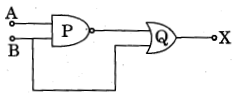
  1. Identify the logic gates marked P and Q in the given logic circuit.

  1. Write down the output at X for the inputs A = 0, B = 0 and A = 1, B = 1.
A bulb is made using two filaments. A switch selects whether the filaments are used individually or in parallel. When used with a 15V battery, the bulb can be operated at 5W, 10W or 15W. What should be the resistances of the filaments?
A copper wire of cross-sectional area 0.01cm2 is under a tension of 20N. Find the decrease in the cross-sectional area. Young's modulus of copper = 1.1 × 10 11N/m2 and Poisson's ratio = 0.32.

$\Big[$Hint: $\frac{\triangle\text{A}}{\text{A}}=2\frac{\triangle\text{r}}{\text{r}}\Big]$

State the use of galvanometer as a voltmeter.
A solenoid of length $0.5 m$ has a radius of $1 cm$ and is made up of 500 turns. It carries a current of $5 A$. What is the magnitude of the magnetic field inside the solenoid?
A compound microscope forms an inverted image of an object. In which of the following cases it is kely to create difficulties?
  1. Looking at small germs.
  2. Looking at circular spots.
  3. Looking at a vertical tube containing some water.