Question
Why the tansition elements are hard and have high melting and boiling points?

Answer

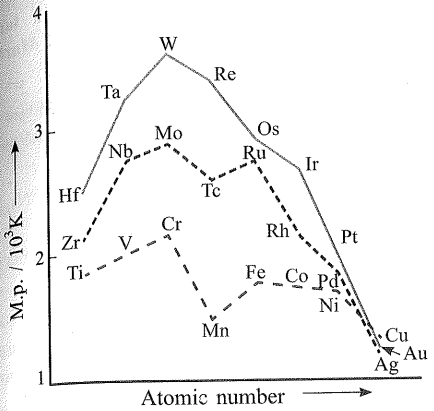
$\rightarrow$ The high melting points of these metals are attributed to the involvement of greater number of electrons from $(n-1)d$ in addition to the ns electrons in the interatomic metallic bonding.
$\rightarrow$ In any row the melting points of these metals rise to a maximum at $d^5$ except for anomalous values of $Mn$ and $Te$ and fall regularly as the atomic number increases.
Image
Trends in melting points of transition elements
$\rightarrow Zn, Cd,$ and $Hg$ are soft and volatile and they have low melting point because all these elements have no unpaired electrons.

Need a full question paper?

Generate a complete, print-ready paper with questions like this in minutes — across 16+ boards, with answer keys.
Start Generating Free

Similar questions

1.25 g of protein is present in 300 mL aqueous solution of a protein. The osmotic pressure of this solution at 300 K was found to be $2.50 \times 10^{-3}$ bar. Calculate the molar mass of protein. $[R=0.083 L$ bar $\operatorname{mol}^{-1} K^{-1}$ ].

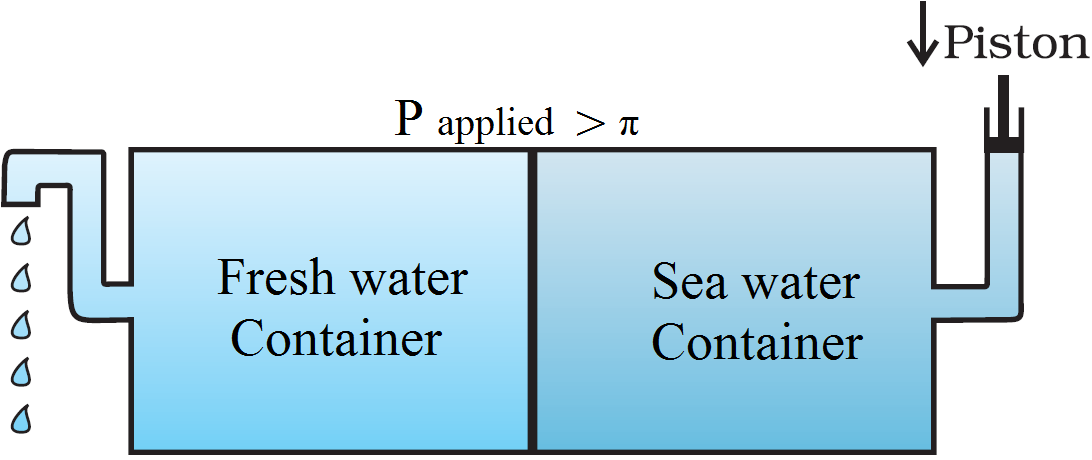
Given alongside is the sketch of a plant for carrying out a process.
  1. Name the process occurring in the given plant.
  2. To which container does the net flow of solvent take place?
  3. Name one SPM which can be used in this plant.
  4. Give one practical use of the plant.
​​​​​​​
Write the cell reaction of a lead storage battery when it is discharged. How does the density of the electrolyte change when the battery is discharged?
Explain three differences between the rate constant of reaction and rate of a reaction.
Complete the following equations :
(i) $CH _3- CH _2- Cl \xrightarrow{+ A } B \xrightarrow{ C } CH _3- CH _2- NH _2+ HCOOH$
(ii) $CH _3- I \xrightarrow{+ A } B \xrightarrow{ C } CH _3- NH - CH _3$
Two isomeric compounds $(A$ and $B)$ have $\ce{ C_4H_{11}N}$ molecular formula react with $\ce{HNO_2}$ and forms compounds $(C)$ and $(D). C$  is hardly oxidised but it reacts immediately with Lucas reagent whereas $D$ reacts with Lucas reagent in $5$ minutes and it also gives haloform reaction. Identify $\ce{A, B, C}$ and $\ce{D}$.
Write the equations of monochlorination and monobromination of propane.
What are chiral objects? Indicate the presence of centre of chirality, if any, in the molecules of 3-bromopent-1-ene.
Explain the mechanism of addition of HCl to propene.
Accomplish the following conversion:
Benzene to m-bromophenol.