Question
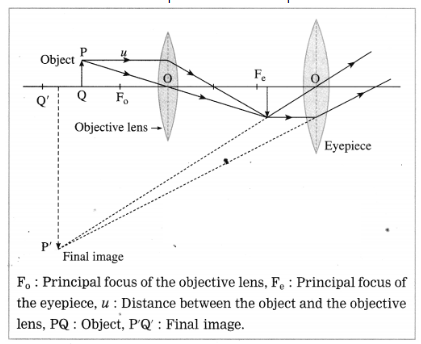
With a neat labelled diagram, explain the construction and working of a compound microscope.
Answer

Construction of a compound microscope:
Image

(1) A compound microscope consists of a metal tube fitted with two convex lenses at the two ends. These lenses are called the objective lens (the lens directed towards the object) and the eyepiece (the lens directed towards the eye). Both the lenses are small in size, but the cross section of the objective lens is less than that of the eyepiece. The objective lens has a short focal length. The focal length of the eyepiece is more than that of the objective lens.

(2) The metal tube is mounted on a stand. The principal axes of the objective lens and the eyepiece are along the same line. The distance between the object and the objective lens can be changed with a screw. It is possible to change the distance between the objective lens and the eyepiece.

Working :
(1) The object to be observed is illuminated and placed in front of the objective lens, slightly beyond the focal length of the objective lens. Its real, inverted and enlarged image is formed by the objective lens on the other side.

(2) This intermediate image lies within the focal length of the eyepiece. It serves as an object for the eyepiece. The eyepiece works as a simple microscope. The final image is virtual, highly enlarged and inverted with respect to the original object. It can be formed at the minimum distance of distinct vision from the eyepiece. The final image is observed by keeping the eye close to the eyepiece.

Need a full question paper?

Generate a complete, print-ready paper with questions like this in minutes — across 16+ boards, with answer keys.

Start Generating Free

Similar questions

How will you increase the strength of magnetic field in an electromagnet?
Write down the following activities in the correct order for a simple reflex arc:
  1. Impulse travels in the motor fibre.
  2. Impulse travels in the sensory fibre.
  3. Effector organ stimulated.
  4. Impulse crosses the synapse.
A scientist removed some cells from the growing point of a plant and placed it in a suitable medium leading to the formation of a shapeless lump of mass X. X is then transferred to another medium which stimulates it to develop roots. When X with developed roots is placed in a yet another medium, then it develops shoots to form tiny plantlets. These plantlets can then be transplanted in pots or soil where they can grow to form mature plants.
  1. What is the shapeless lump of mass X known as?
  2. What name is given to this method of producing new plants?
  3. The growth medium used in this method contains plant nutrients in the form of a 'jelly'. Name this jelly.
  4. What is the general name of chemicals used to stimulate the growth of plant cells and development of roots and shoots?
  5. Name any two plants which are produced by this method.
  6. State any two advantages of this method of producing plants.
  7. What is the other name of this method [other then that given in (b) above]?
Write the full forms of the following:
INSAT, GSAT, IRNSS, GSLV, PSLV, ISRO, NASA.
Using the law of conservation of energy, obtain the expression for the escape velocity
What is the reaction called when oxidation and reduction take place simultaneously?
In a Std. X class, out of 40 students, 10 students use spectacles, 2 students have ( positive power and 8 students have negative power of lenses in their spectacles.
Answer the following questions:
(1) What does the negative power indicate?
(2) What does the positive power indicate?
(3) Generally which type of spectacles do most of the students use?
(4) What defect of eyesight do most of the students suffer from?
(5) Give two possible reasons for the above defect.
The following diagram shows a part of the periodic table in which the elements are arranged according to their atomic numbers.
(The letters given here are not the chemical symbols of the elements):
a
3
b
4
 
c
5
d
6
e
7
f
8
g
9
h
10
i
11
j
12
 
k
13
l
14
m
15
n
16
o
17
p
18
  1. Which element has a bigger atom, a or f?
  2. Which element has a higher valency, k or o?
  3. Which element is more metallic, i or k?
  4. Which element is more non-metallic, d or g?
  5. Select a letter which represents a metal of valency 2.
  6. Select a letter which represents a non-metal of valency 2.
State and explain Maxwell’s right-hand thumb rule.
What is the valency of elements with atomic number 8, 14, 17 and 20?