Question
With the help of a suitable example, explain how ionic compounds are formed State any three general properties of ionic compounds.

Answer

Ionic compounds are formed when a metal and a non metal react with each other.ie, positive and negative charges. eg: Na(metal) + Cl(non memtal) - NaCl
Properties: Ionic compounds have a strong electrostatic force of attraction. They have high melting and boiling points. They can dissolve in other ionic compunds like water.

Need a full question paper?

Generate a complete, print-ready paper with questions like this in minutes — across 16+ boards, with answer keys.
Start Generating Free

Similar questions

The pH values of five solutions A, B, C, D and E are given below:
  1. 1
  2. 5
  3. 7
  4. 11
  5. 13
Which solution is:
  1. Weakly alkaline.
  2. Neutral.
  3. Strongly acidic.
  4. Strongly alkaline, and.
  5. Weakly acidic?
A metal carbonate X on reacting with an acid gives a gas which when passed through a solution Y gives the carbonate back. On the other hand, a gas G that is obtained at anode during electrolysis of brine is passed on dry Y, it gives a compound Z, used for disinfecting drinking water. Identity X, Y, G and Z.
On heating blue coloured powder of copper (II) nitrate in a boiling tube, copper oxide (black), oxygen gas and a brown gas X is formed.
  1. Write a balanced chemical equation of the reaction.
  2. Identity the brown gas X evolved.
  3. Identity the type of reaction.
  4. What could be the pH range of aqueous solution of the gas X?
Explain why, a salt which does not conduct electricity in the solid state becomes a good conductor in molten state.
On heating blue coloured powder of copper (II) nitrate in a boiling tube, copper oxide (black), oxygen gas and a brown gas X is formed.
  1. Write a balanced chemical equation of the reaction.
  2. Identity the brown gas X evolved.
  3. Identity the type of reaction.
  4. What could be the pH range of aqueous solution of the gas X?
A colourless organic liquid X of molecular formula C2H4O2 turns blue litmus to red. Another colourless organic liquid Y of molecular formula C3H6O has no action on any litmus but it is used as a nail polish remover. A yet another colourless organic liquid Z of molecular formula C2H6O has also no action on litmus but it is used in tincture of iodine.
  1. Name the liquid X. To which homologous series does it belong? Give the name of another member of this homologous series.
  2. Name the liquid Y. To which homologous series does it belong? Write the name of another member of this homologous series.
  3. Can you name an organic compound having the same molecular formula as liquid Y but which belongs to a different homologous series? What is this homologous series?
  4. Name the liquid Z. To which homologous series does it belong? Write the name of another member of this homologous series.
With the help of labelled diagrams, describe an activity to show that acids produce ions only in aqueous solutions.
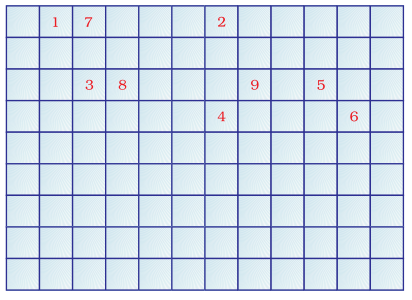
Complete the following cross word puzzle (Figure).

Across:

  1. An element with atomic number 12.

  1. Metal used in making cans and member of Group 14.

  2. A lustrous non-metal which has 7 electrons in its outermost shell.

​​​​​​​Down:

  1. Highly reactive and soft metal which imparts yellow colour when subjected to flame and is kept in kerosene.

  1. The first element of second Period.

  2. An element which is used in making fluorescent bulbs and is second member of Group 18 in the Modern Periodic Table.

  3. A radioactive element which is the last member of halogen family.

  4. Metal which is an important constituent of steel and forms rust when exposed to moist air.

  5. The first metalloid in Modern Periodic Table whose fibres are used in making bullet-proof vests.

Give the structural differences between saturated and unsaturated hydrocarbons with two examples, each.
No chemical reaction takes place when granules of a rusty-brown solid A are mixed with the powder of another solid B. However, when the mixture is heated, a reaction takes place between its components. One of the products C is a metal and settles down in the molten state while the other product D floats over it. It was observed that the reaction is highly exothermic.
  1. What could the solids A and B be?
  2. What are the products C and D most likely to be?
  3. Write the chemical equation for the reaction between A and B leading to the formation of C.and D. Mention the physical sates of all the reactants and products in this equation and indicate the heat change which takes place.
  4. What is the special name of such a reaction? State one use of such a reaction.
  5. Name any two types of chemical reactions under which the above reaction can beclassified.