MCQ
With the increase in principal quantum number, the energy difference between the two successive energy levels
  • A
    remains constant
  • B
    increases
  • decreases
  • D
    sometimes increases and sometimes decreases

Answer

Correct option: C.
decreases
C

Need a full question paper?

Generate a complete, print-ready paper with questions like this in minutes — across 16+ boards, with answer keys.
Start Generating Free

Similar questions

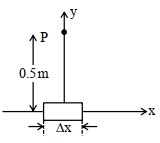
An element $\Delta l=\Delta \mathrm{xi}$ is placed at the origin and carries a large current $\mathrm{I}=10 \mathrm{~A}$. The magnetic field on the $y$-axis at a distance of $0.5 \mathrm{~m}$ from the elements $\Delta \mathrm{x}$ of $1 \mathrm{~cm}$ length is:
A plane wave $y=A\,\, sin\,\, \omega \left( {t - \frac{x}{v}} \right)$ undergo a normal incidence on a plane boundary separating medium $M_1$ and $M_2$ and splits into a reflected and transmitted wave having speeds $v_1$ and $v_2$ then
A sphere of solid material of relative density $9$ has a concentric spherical cavity and  floats having just sinked in water. If the radius of the sphere be $R$, then the radius of  the  cavity $(r)$ will be related to $R$ as :-
In $X-$ ray experiment $K_{\alpha}$, $K_{\beta}$ denotes
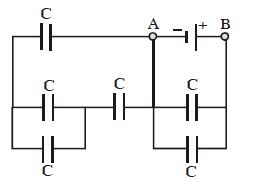
Find equivalent capacitance between $A$ and $B$
The intensity variation in the interference pattern obtain with the help of two coherent sources is $5\%$ of the average intensity. Find out the ratio of intensities of two sources
Read the following statements:

$(A)$ Volume of the nucleus is directly proportional to the mass number.

$(B)$ Volume of the nucleus is independent of mass number.

$(C)$ Density of the nucleus is directly proportional to the mass number.

$(D)$ Density of the nucleus is directly proportional to the cube root of the mass number.

$(E)$ Density of the nucleus is independent of the mass number.

Choose the correct option from the following options.
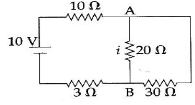
In the electrical circuit shown in the figure, the current $i$ through the side $AB$ is
Mud houses are cooler in summer and warmer in winter because
A satellite which is geostationary in a particular orbit is taken to another orbit. Its distance from the centre of earth in new orbit is $2$ times that of the earlier orbit. The time period in the second orbit is