Question
Work done by a force is given by $\text{W}=\vec{\text{F}.}\vec{\text{S}}\text{ Where}\vec{\text{ F}}$ is the force and $\vec{\text{S}}$is the displacement. Show that:
  1. Work done is also equal to change in K.E.
  2. Work done is also equal to change in potential energy using this expression.

Answer

  1.  

m = mass of body at rest
$\vec{\text{ds}}$ = small displacement in the direction of force Small amount of work done by force
$\text{dW}=\vec{\text{F}}.\vec{\text{ds}}$
$=\text{FdS}\cos0^\circ=\text{FdS}$
If is acceleration Produced in the body, then
$\vec{\text{F}}=\text{m}\vec{\text{a}}=\text{m}\frac{\text{dv}}{\text{dt}}$
$\text{dW}=\bigg(\text{m}\frac{\text{dv}}{\text{dt}}\bigg).\text{dS}=\text{m}\bigg(\frac{\text{dS}}{\text{dt}}\bigg)\text{dv}$
$=\text{mv}\text{ dv}$
Total work done by the force
$\text{W}=\int_\limits{0}^{\text{v}}\text{vdv}=\text{m}\bigg[\frac{\text{v}^2}{2}\bigg]_0^\text{v}$
$\text{W}=\frac{1}{2}\text{mv}^2$
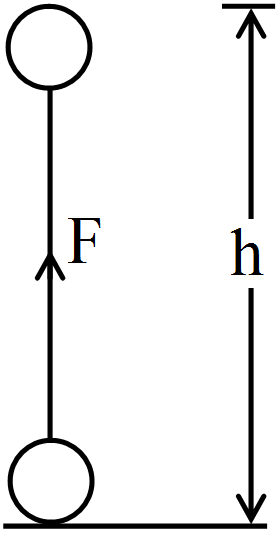
  1. F = mg

As the distance is moved in the direction of force applied
Work done = Force distance
W = F × h = mgh

Need a full question paper?

Generate a complete, print-ready paper with questions like this in minutes — across 16+ boards, with answer keys.

Start Generating Free

Similar questions

Given a + b + c + d = 0, which of the following statements are correct: a, b, c, and d must each be a null vector.
A body is moving with a uniform acceleration. Its velocity after 5 seconds is $25m/s$ and after $8$ seconds is $34m/s$. Calculate the distance it will cover in $10^{th}$ second.
Two blocks of equal mass m are tied to each other through a light string. One of the blocks is pulled along the line joining them with a constant force F. Find the tension in the string joining the blocks.
A body of mass 5 kg is acted upon by two perpendicular forces 8 N and 6 N . Give the magnitude and direction of the acceleration of the body.
A man of mass $70kg$ stands on a weighing scale in a lift which is moving. Upwards with a uniform acceleration of $5ms^{-2}$. What would be the readings on the scale in each case?
The voltage across a lamp is $\text{V}=(6.0\pm0.1)$ Volt and the current passing through it $\text{I}=(4\pm0.2)$ ampere. Find the power consumed by the electric lamp. Given that power, P = VI
Estimate the total number of air molecules (inclusive of oxygen, nitrogen, water vapour and other constituents) in a room of capacity $25.0m^3$​​​​​​​ at a temperature of $27°C$ and $1$ atm pressure.
A small block of mass is pressed against a horizontal spring fixed at one end to compress the spring through 5.0cm. When released the block moves horizontally till it leaves the spring. Where will it hit the ground at a distance 2m below the slab? [k = 100N/ m, m = 100g)
State which of the following situations are possible and give an example for each of these?
  1. An object with a constant acceleration but with zero velocity.
  2. An object moving in a certain direction with acceleration in the perpendicular direction.
Derive an expression for the work done in an isothermal process.