Question
Write a note on DDT.

Answer

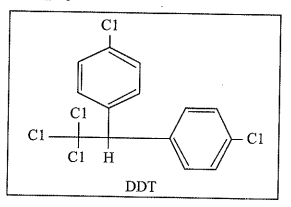
→ DDT, the first chlorinated organic insecticides, was originally prepared in 1873, but it was not until 1939 that Paul Muller of Geigy Pharmaceuticals in Switzerland discovered the effectiveness of DDT as an insecticide.
→ Paul Muller was awarded the Nobel Prize in Medicine and Physiology in 1948 for this discovery.
→ The use of DDT increased enormously on a worldwide basis after world war II, primarily because of its effectiveness against the mosquito that spreads malaria and lice that carry typhus.
→ However, problems related to extensive use of DDT began to appear in the late 1940s.
Image
→ Many species of insects developed resistance to DDT, and it was also discovered to have a high toxicity towards fish.
→ The chemical stability of DDT and its fat solubility compounded the problem.
→ DDT is not metabolised very rapidly by animals; instead, it is deposited and stored in the fatty tissues.
→ If ingestion continues at a steady rate, DDT builds up within the animal over time.
→The use of DDT was banned in the United States in 1973, although it is still in use in some other parts of the world.

Need a full question paper?

Generate a complete, print-ready paper with questions like this in minutes — across 16+ boards, with answer keys.

Start Generating Free

Similar questions

Although Cr3+ and Co2+ ions have same number of unpaired electrons but the magnetic moment of Cr3+ is 3.87 B.M. and that of Co2+ is 4.87 B.M. Why?
Answer the following question:
An organic compound A having molecular formula C6H6O gives a characteristic colour with aqueous FeCl3 solution. A on treatment with CO2 and NaOH at 400K under pressure gives B which on acidification gives a compound C. The compound C reacts with acetyl chloride to give D which is a popular pain killer. Deduce the structure of A, B, C and D.
The rate constants of a reaction at 500K and 700K are 0.02 S-1 and 0.07S-1 respectively. Calculate the values of E_{s} and A.
$\left[ R =8.314 JK ^{-1} mol^{-1}\right]$
Explain kohlrausch Law with example.
Calculate the magnetic moment of a divalent ion in aqueous solution if its atomic number is 25.
An organic compound ‘A’ having molecular formula C3H6 on treatment with aqueous H2SO4 gives ‘B’ which on treatment with HCl/ ZnCl2 gives ‘C’. The compound C on treatment with ethanolic KOH gives back the compound ‘A’. Identify the compounds A, B, C.
Give information about C-O-H bond angle in alcohol, phenol and ether with suitable example.
  1. What is the basis of formation of the spectro-chemical series?
  2. Draw the structures of geometrical isomers of the following coordination complexes:

[Co(NH3)3Cl3] and [CoCl2(en)2]+.

(en = ethylenediamine and atomic number of Co is 27).

  1.  What type of isomerism is shown by [Co(NH3)5ONO]Cl2?
  2. On the basis of crystal field theory, write the electronic configuration for dion if $\Delta$ o< P.
  3. Write the hybridization and shape of [Fe(CN)6]3-.

(Atomic number of Fe = 26)

Discuss the nature of bonding in metal carbonyls.