Question
Write a note on nitrogen fixation?

Answer

Nitrogen fixation is the process of fixing free nitrogen into compounds.
This takes place by the following means:
  • Certain blue-green algae and bacteria can fix atmospheric nitrogen.
  • Nitrogen fixing bacteria found in the nodules of roots of legumes such as gram, bean, pulses etc. fix atmospheric nitrogen into nitrogen containing compounds.
  • Lightning also helps in the formation of nitrogen containing compounds.

Need a full question paper?

Generate a complete, print-ready paper with questions like this in minutes — across 16+ boards, with answer keys.
Start Generating Free

Similar questions

Draw a diagrammatic sketch of oxygen cycle in nature.
The scientists now say that there are actually five states of matter $A, B, C, D$ and $E$. The state A has a fixed volume but no fixed shape. The state B can be compressed very easily by applying pressure and state $C$ has a fixed shape as well as a fixed volume. The state $D$ is mixture of free electrons and ions whereas state E is named after an Indian scientist and a famous physicist.
  1. Name the physical states $(i) A\ (ii) B\ (iii) C\ (iv) D$, and $(v) E$.
  2. Name one substance belonging to state $C$ which can directly change into vapours on heating. What is this process known as?
  3. Name one substance which normally belongs to state B but whose solid form changes directly into gaseous state.
  4. Name the most common substance belonging to state $A$.
  5. Which state of matter makes the sum and other stars to glow.
If a balloon filled with air and its mouth untied, is released with its mouth in the downward direction, it moves upwards. Why?
Give one example of hemichordata, urochordata and cephalochordata.
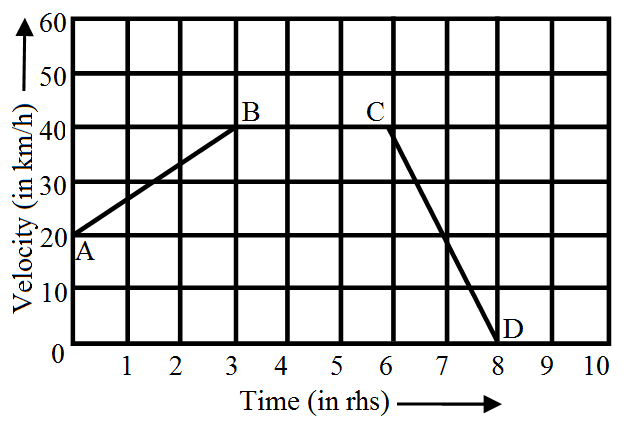
Given alongside is the velocity-tine graph for a moving body:

Find:
  1. Velocity of the body at point $C.$
  2. Acceleration acting on the body between $A$ and $B.$
  3. Acceleration acting on the body between $B$ and $C.$
Name seven types of cells found in stem of sun flower.
Define drought.
The following is the distance-time table of an object in motion:
Time (s)Distance (m)
00
11
28
327
464
5125
6216
7343

a. What conclusion can you draw about the acceleration? Is it constant, increasing, decreasing, or zero?
b. What do you infer about the forces acting on the object?
State in brief the principle of immunisation.
Two identical bullets are fired one by a light rifle and another by a heavy rifle with the same force. Which rifle will hurt the shoulder more and why?