Question
Write a note on relationship between Accounting Information System, Manufacturing Information System and Human Resource System.
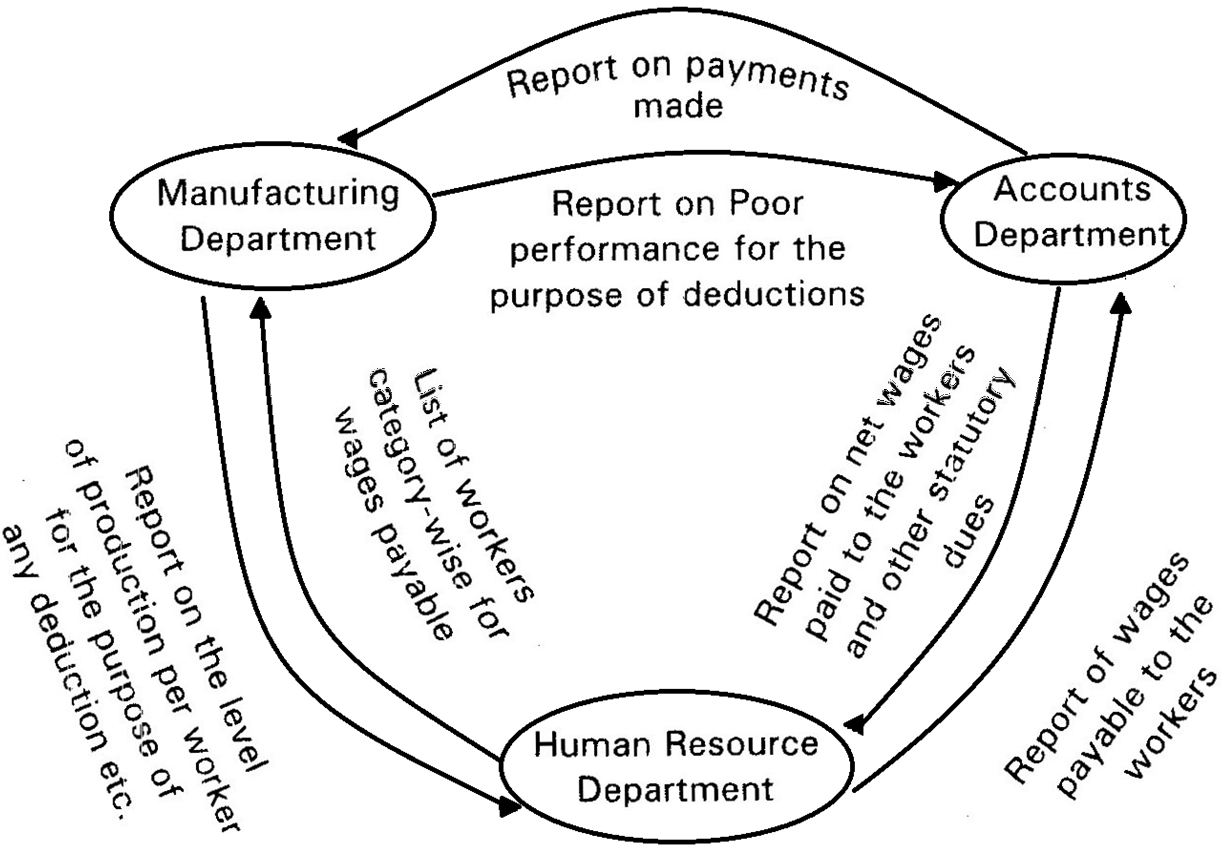 The above diagram depicts how the three functional departments are mutually related. The human resource department sends a list of number of workers, their category their level of skill etc. to the manufacturing department and to the accounts department. The manufacturing department on receiving such list sends a report of level of production achieved by each worker and other deductions to be made from their wages on various Accounts. This report is send by the manufacturing department to both Accounts department as well as the HR department. The accounts department on receiving such reports make its own calculations of the various statutory payments and dues of the workers and make the final payments and send the report of the same to both HR Department as well as the manufacturing department to monitor the performance of the workers.
Generate a complete, print-ready paper with questions like this in minutes — across 16+ boards, with answer keys.
| Particulars | ₹ | Particulars | ₹ |
| Capital | 65,000 | Stock ($1^{\text {st }}$ April, 2022) | 32,000 |
| Creditors | 36,800 | Debtors | 12,500 |
| Rent Received | 600 | Cash at Bank | 22,560 |
| Purchases Return | 4,000 | Drawings | 5,000 |
| Sales | 2,89,600 | Purchases | 1,71,000 |
| Provision for Doubtful Debts | 600 | Carriage Inwards | 1,500 |
| Advertisement Expenses | 16,050 | Wages | 23,000 |
| Goodwill | 49,000 | Power | 9,000 |
| Machinery | 20,000 | Insurance | 22,000 |
| Discounts Received | 1,800 | Salaries | 46,390 |
| General Expenses | 8,600 | Income Tax | 5,000 |
| Sales Return | 600 | Bank Loan | 55,000 |
| Discount Allowed | 5,000 | Interest on Bank Loan | 1,500 |
| Patents | 2,700 |
Adjustments:
i. On $31^{\text {st }}$ March, 2023, stock is valued at cost ₹ 23,000 .
ii. A furniture costing ₹ 45,000 was purchased on $1^{\text {st }}$ July, 2022 but it was not recorded in the books as payment was not made for it. Wages ₹ 5,000 were paid for assembling which have been debited to Wages Account.
iii. Provide depreciation on both Machinery and Furniture @10%p.a. and amortise patents by one-third.
iv. Increase Provision for Doubtful Debts to ₹ 2,000 .
v. Carry forward $\frac{2}{3}$ rd Advertisement Expenses as unexpired.
vi. Annual Insurance premium of ₹ 1,200 has been paid up to $30^{\text {th }}$ June, 2023.
vii. Manager is to get $10 \%$ commission on net profit before charging such commission.
viii. A fire broke out on $25^{\text {th }}$ March, 2023 destroying goods costing ₹ 20,000, which were not insured.
| Name of Accounts | Amt(Rs) | Name of Accounts | Amt(Rs) |
| Salaries | 20,446 | Sales | 1,32,840 |
| Bills receivable | 12,754 | Capital | 1,00,000 |
| Investments | 80,000 | Provision for doubtful debts | 5,000 |
| Furniture | 24,000 | 10% Loan (1st October, 2012) | 20,000 |
| Opening stock | 9,000 | Discount received | 800 |
| Purchases | 60,000 | Sundry creditors | 18,600 |
| Sundry debtors | 40,000 | Bills payable | 10,000 |
| Interest on loan | 800 | Outstanding salaries | 1,000 |
| Insurance premium | 1,800 | Bad debts recovered | 400 |
| Wages | 9,200 | Interest on investments | 4,000 |
| Rent | 3,040 | Trading commission | 14,000 |
| Bad debts | 2,400 | ||
| Carriage Outwards | 1,200 | ||
| Cash at Bank | 20,000 | ||
| Depreciation of furniture | 5,000 | ||
| Accrued commission | 2,000 | ||
| Advertisement | 15,000 | ||
| 3,06,640 | 3,06,640 |