Question
Write a self-explanatory note on biopatent.

Answer

It is a set of exclusive rights granted by a government to the inventors or their assignee to prevent others from commercial use of their invention. And when patent is granted for biological entities and for products derived from them, they are called biopatents. Primarily USA, Japan and members of European Union are awarding biopatents.

Need a full question paper?

Generate a complete, print-ready paper with questions like this in minutes — across 16+ boards, with answer keys.

Start Generating Free

Similar questions

Explain- Restriction enzymes.
Read the following and answer any four questions from (i) to (v) given below:

Priya was 4 years old when she contracted chicken pox. It took her around 15 days to recover completely. Now Priya is 5 years old, so her mother got her vaccinated few days back for DPT (5th dose) as per immunisation program. Recently she was playing with her friend in the park when her friend accidently fell on iron pipe and badly bruised her knee. She was taken to the hospital where doctor gave her ATS injection and painkillers. Based on the above information, answer the following questions.

  1. Select the correct statement.
  1. Priya has developed natural active immunity against chicken pox.
  2. Priya has developed artificial active immunity against DPT.
  3. Priya's friend has developed artificial passive immunity against tetanus.
  4. All of these
  1. Which of the following do you think is an example of natural passive immunity?
  1. Administration of AGS (anti gas gangrene serum) in a person.
  2. Transfer of IgA antibodies from mother to baby through mother's milk.
  3.  A person recovered from viral infection.
  4. A child vaccinated for polio.
  1. Which of the following is true for active immunity?
  1. It provides immediate relief.
  2. It is temporary, not long lasting
  3. It has no side effects.
  4. None of these
  1. Select the incorrect match.
  1. Passive immunity-IgG antibodies crossing placental barrier to reach fetus.
  2. Active immunity-Vaccination against corona virus.
  3. Active immunity-Administration of antidiphtheria serum in patient.
  4. Passive immunity-Fetus having mother's milk.
  1. Assertion: A person recovered from measles develops an active immunity against this infection.

Reason: In active immunity, person's own cells develop antibodies in response to infection.
  1. Both assertion and reason are true and reason is the correct explanation of assertion.
  2. Both assertion and reason are true, but reason is not the correct explanation of assertion.
  3. Assertion is true, but reason is false.
  4. Both assertion and reason are false.
Read the following and answer any four questions from (i) to (v) given below:

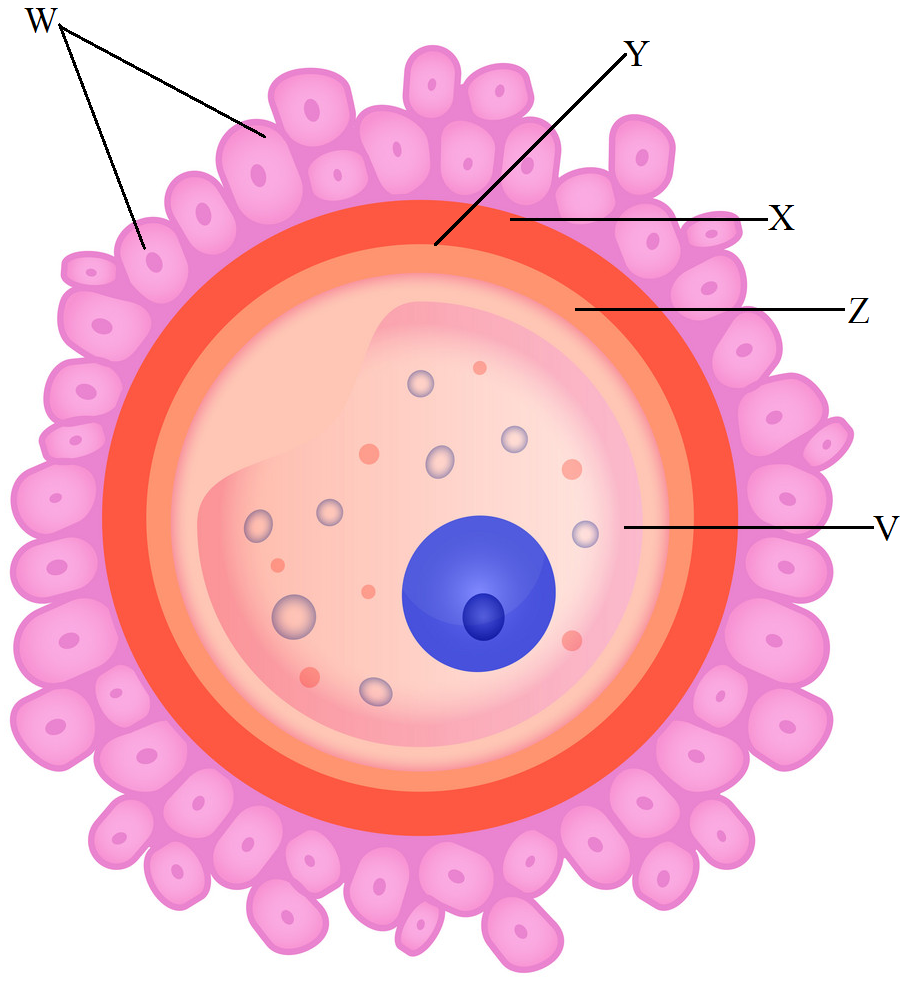
The mature ovum or a female gamete is spherical in shape. The human ovum is almost free of yolk and is said to be alecithal. Human ovum loses its ability to be fertilised about 24 hours after ovulation. Refer to the given structure of ovum and answer the following questions.

  1. Thick cellular layer formed of radially elongated follicular cells is:
  1. Zona pellucida.
  2. Plasma membrane.
  3. Perivitelline membrane.
  4. Corona radiata.
  1. In humans, at which stage does ovum get released from ovary?
  1. Secondary oocyte.
  2. Oogonium.
  3. Primary oocyte.
  4. First polar body.
  1. Cytoplasm of an ovum is enveloped by _____.
  1. Zona pellucida.
  2. Corona radiata.
  3. Cell membrane.
  4. Perivitelline space.
  1. Select the correct option:
S. No
V
W
X
(a)
Cytoplasm
Zona pellucida
Plasma membrane
(b)
Cortical granules
Corona radiata
Zona pellucida
(c)
Cortical granules
Plasma membrane
Corona radiata
(d)
Cytoplasm
Corona radiata
Zona pellucida
  1. Which of the following is not a characteristic of an ovum?
  1. Nucleus of an ovum has prominent nucleolus.
  2. Only one ovum formed from one oogonium.
  3. It lacks centrioles.
  4. It has very small amount of ooplasm.
The bacterium Bacillus thuringiensis is widely used in contemporary biology as:
  1. Agent for production of dairy products.
  2. Source of industrial enzyme.
  3. Indicator of water pollution.
  4. Insecticide.
Read the following and answer any four questions from (i) to (v) given below:

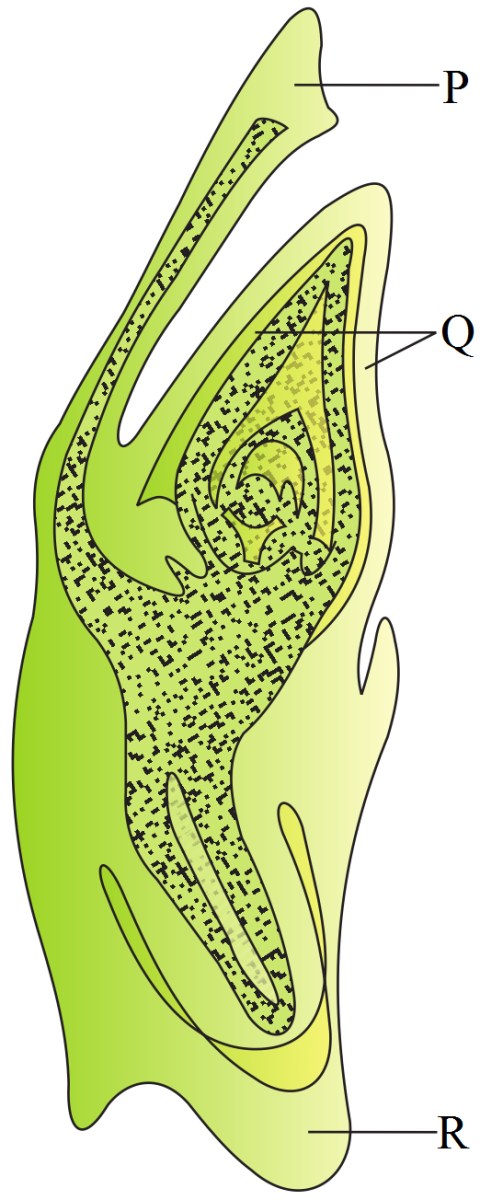
Embryo develops at the micropylar end of the embryo sac, where the zygote is situated. Most zygotes divided only after certain amount of endosperm is formed. The early stages of embryo development are similar in both monocotyledons and dicotyledons. The zygote gives rise to the proembryo and subsequently to the globular heart-shaped and mature embryo. A typical dicotyledonous embryo consists of an embryonal axis and two cotyledons. Embryo of monocotyledons possess only one cotyledon.

  1. True embryo develops as a result of fusion of:
  1. Two polar nuclei of embryo sac.
  2. An egg cell and a male gamete.
  3. Synergid and male gamete.
  4. A male gamete and antipodals.
  1. Refer to the given diagram of the embryo of an angiospermous plant with parts labelled P, Q and R. Select the correct statement(s) regarding this.

  1. Part 'P' supplies nutrition to the developing embryo.
  2. Part 'Q' is the protective sheath of radicle and root cap.
  3. Part 'R' is the protective sheath of shoot apex and leaf primordia.
  4. The embryo shown in the diagram is present in members of Family Poaceae.
  1. (IV) only.
  2. (II) and (III) only.
  3. (I) and (IV) only.
  4. (I), (II), (III) and (IV).
  1. Which of the given statements are true?
  1. During the development of a dicot embryo, heart-shaped embryo is followed by globular embryo.
  2. The part of embryonal axis above the level of cotyledons is epicotyl, while the part below the level of cotyledons is hypocotyl.
  3. Monocot seeds possess a single cotyledon, represented by scutellum.
  1. (I) and (II).
  2. (II) and (III).
  3. (I) and (III).
  4. (I), (II) and (III).
  1. Consider the following parts of an embryonal axis of a dicot seed.
  1. Hypocotyl.
  2. Epicotyl.
  3. Radicle.
  4. Plumule.

In which of the following the above parts are correctly arranged from top to base?
  1. (III) → (I) → (II) → (IV).
  2. (II) → (I) → (III) → (IV).
  3. (IV) → (II) → (I) → (III).
  4. (III) → (IV) → (II) → (I).
  1. In grass family, the cotyledon, is called:
  1. Epiblast.
  2. Plumule.
  3. Scutellum.
  4. Perisperm.
Read the following text carefully and answer the questions that follow:
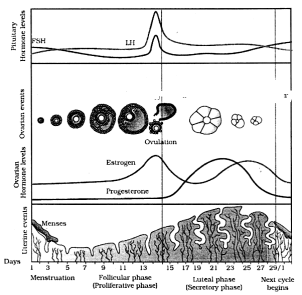
The reproductive cycle in female primates (e.g. monkeys, apes and human beings) is called the menstrual cycle. In human females, menstruation is repeated at an average interval of about 28/29 days, and the cycle of events starting from one menstruation till the next one is called the menstrual cycle Anita has show Diagrammatic presentation of various events during a menstrual cycle.
Image
i. What role do pituitary gonadotropins play during the follicular and ovulatory phases of the menstrual cycle? (1)
ii. The first half of the menstrual cycle is called the proliferative phase as well as the follicular phase. Give reason.(2)
iii. Why does corpus luteum stay active throughout pregnancy and in the absence of fertilization, is active only for 10-12 days?
OR
What happens to corpus luteum in human female if the ovum is (2)
a. fertilised,
b. not fertilised?
Microbes can be used to decrease the use of chemical fertilizers and pesticides. Explain how this can be accomplished.###How biofertilizers increase fertility of soil?
Read the following text carefully and answer the questions that follow:
Malaria and dengue fever are major mosquito-borne public health problems in tropical countries. The authors report a malaria and dengue co-infection in an 11-year-old boy who presented with sustained fever for 10 days. The physical examination revealed a flushed face, injected conjunctivae and left submandibular lymphadenopathy. His peripheral blood smear showed few ring-form trophozoites of Plasmodium falciparum. His blood tests were positive for dengue NS-1 antigen and IgM antibody, and negative for IgG antibody. After the initiation of antimalarial treatment with artesunate and mefloquine, his clinical condition gradually improved. However, he still had low-grade fever that persisted for 6 days. Finally, he recovered well without fluid leakage, shock or severe bleeding.
i. Name the fish that help in eradication of mosquito larvae.
ii. What is the reason of symptoms of malaria?
iii. Name the body parts and host in which following events takes place in life cycle of plasmodium.
a. asexual reproduction
b. sexual reproduction.
OR
Name some vector borne diseases and their vector.
Match the terms in Column I with those in Column II.
S. No Column I S. No Column II
(i) Gene therapy 1. Human insulin.
(ii) Cotton bollworm 2. Biopiracy.
(iii) Eli Lilly 3. Emphysema.
(iv) Basmati Rice 4. ADA deficiency.
(v) $\alpha-1\text{ antitrypsin}$ 5. Lepidopteran.
Read the following and answer any four questions from (i) to (v) given below:

Mutation explains the relationship between gene and DNA. The effects of large deletions and rearrangement in a segment of DNA results in loss or gain of gene and its function. Insertion or deletion of one or two bases changes the reading frame from the point of insertion or deletion. A classical example of point mutation is a change of single base pair in the gene for beta globin chain that results in change of amino acid residue glutamate to valine and results into a diseased condition called sickle cell anaemia.

  1. A mutation is a change produced by an alteration in the genetic mechanism and.
  1. May arise spontaneously.
  2. Is always induced by the environment.
  3. Is never advantageous.
  4. Is not inherited.
  1. The DNA code for glutamic acid is CTC or CTT. The code for valine is CAA or CAT. In sickle cell haemoglobin, valine is present instead of glutamic acid.

Assuming a single base pair substitution has occurred, what is the mRNA code in the affected mutant?

  1. CUU
  2. GAA
  3. GAG
  4. GUA
  1. A mutation involving the substitution of one nitrogenous base for another has altered the base sequence of a DNA molecule, coding for four amino acids, as shown below.

Normal A-G-C-A-T-G-G-A-T-C-C-T

Mutant A-G-C-A-T-G-C-A-T-C-C-T

The table shows six codons and the corresponding amino acids into which each is translated.

mRNA codon
Amino acid
AAG
Lysine
CUA
Leucine
GGA
Glycine
GUA
Valine
UAC
Tyrosine
UCG
Serine
The mutation has changed the amino acid.

  1. Leucine to valine.
  2. Lysine to glycine.
  3. Serine to leucine.
  4. Tyrosine to lysine.
  1. Assertion : Insertion or deletion of three or its multiple bases, insert or delete one or multiple codons and so one or multiple amino acids.

Reason: Reading frame remains unaltered with insertion or deletion of three or its multiple bases.

  1. Both assertion and reason are true, and reason is the correct explanation of assertion.
  2. Both assertion and reason are true, but reason is not the correct explanation of assertion.
  3. Assertion is true, but reason is false.
  4. Both assertion and reason are false.
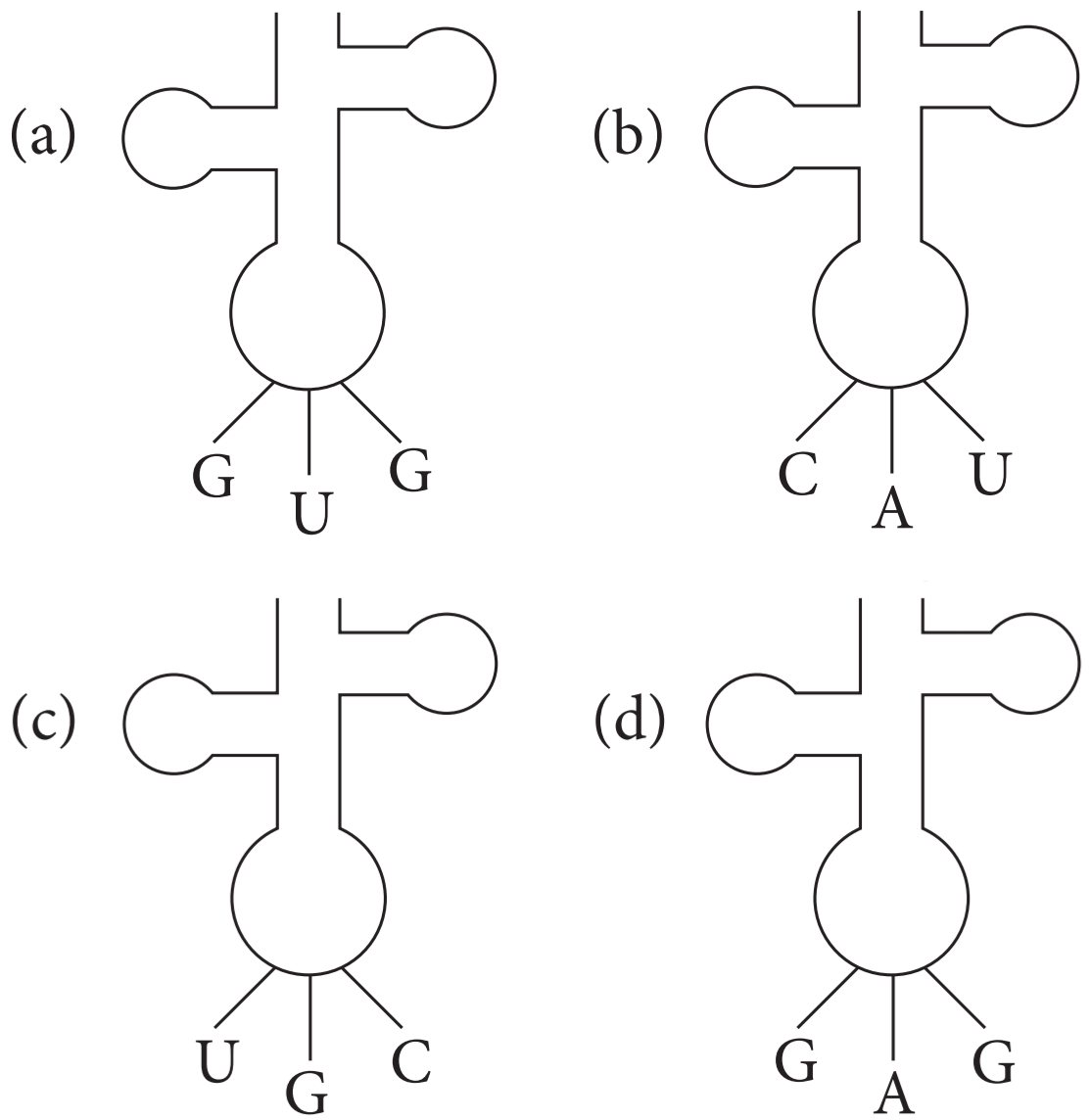
  1. Part of the amino acid sequences in normal and sickle cell haemoglobin are shown.
Normal haemoglobin Sickle cell haemoglobin
Thr-Pro-Glu-Glu Thr-Pro-Val-Glu
mRNA codons for these amino acids are

Glutamine (Glu) GAA GAG

Praline (Pro) CCU CCC

Threonine (Thr) ACU ACC

Valine (Val) GUA GUG

Which transfer RNA molecule is involved in the formation of this part of the sickle cell haemoglobin?