Question
Write down the equation of electric potential for a point - outside the spherical shell - on the surface of a spherical shell and - inside the spherical shell.
Answer

Generally, for a spherical shell, the electric field for a point outside the surface of shell is such that the entire charge of shell can be considered as concentrated at its centre.
The value of electric potential that we get for a point outside the surface of shell is also got (derived) in a similar way.
$V =\frac{1}{4 \pi \varepsilon_0} \cdot \frac{q}{r}(r \geq R )$

Where, $q$ - total electric charge on the shell
R - radius of the shell
$r$ - the distance of the point from the centre of the shell.

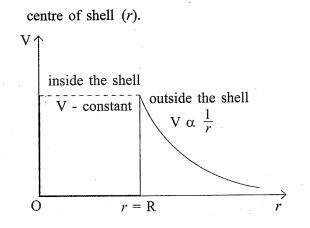
The electric field inside the shell is zero, therefore potential inside remains constant.
Because as there is no electric field inside, the work done in taking the charge from one point to the other is zero.

$\begin{array}{l}
\therefore \text { In } W =q \Delta V , \\
\text { because } W =0 \\
\therefore \Delta V =0 \\
\therefore V =\text { constant }
\end{array}$

and that value of potential is same as the value on the surface of shell.
$\therefore V =\frac{1}{4 \pi \varepsilon_0} \cdot \frac{q}{ R } \quad(\because r \leq R )$

Below figure (graph) shows the variation of electric potential $( V )$ versus distance from the

Image

Need a full question paper?

Generate a complete, print-ready paper with questions like this in minutes — across 16+ boards, with answer keys.
Start Generating Free

Similar questions

Can fringes of white light be formed in interference or not? If yes, under what circumstances?
Write the factors affecting the capacitance of a capacitor.
Explain how does the polarized dielectric modify the original external field inside it ?
The susceptibility of magnesium at 300K is 1.2 × 10-5. At what temperature will the susceptibility increase to 1.8 × 10-5?
Write the statements of Kirchhoff's laws.
Why are elemental dopants for Silicon or Germanium usually chosen from group XIII or group XV?
A hydrogen atom contains one proton and one electron. It may be assumed that the electron revolves in a circle of radius 0.53 angstrom (1 angstrom = 10-10m and is abbreviated as A) with the proton at the centre. The hydrogen atom is said to be in the ground state in this case. Find the magnitude of the electric force between the proton and the electron of a hydrogen atom in its ground state.
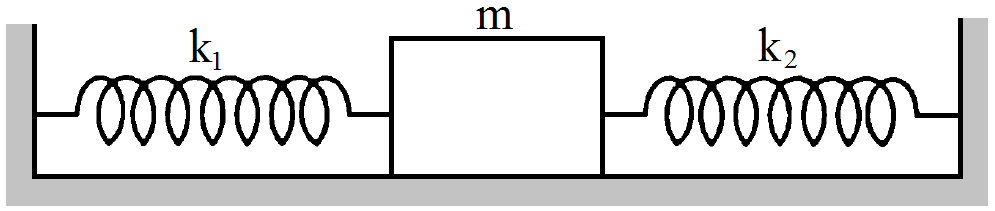
A block of mass m is attached to two unstretched springs of spring constants k1 and k2 as shown in figure. The block is displaced towards right through a distance x and is released. Find the speed of the block as it passes through the mean position shown.

Define refractive index of a transparent medium.
A ray of light passes through a triangular prism. Plot a graph showing the variation of the angle of deviation with the angle of incidence.
The $\text{K}_\beta$ X-ray of argon has a wavelength of 0.36nm. The minimum energy needed to ionize an argon atom is 16eV. Find the energy needed to knock out an electron from the K shell of an argon atom.