Question
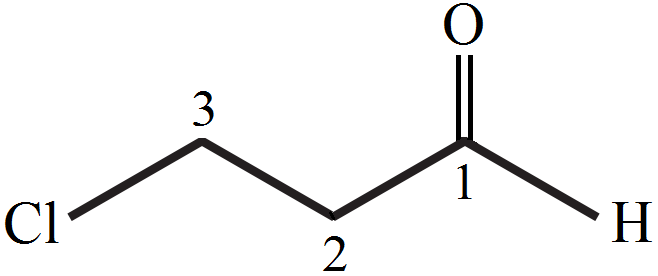
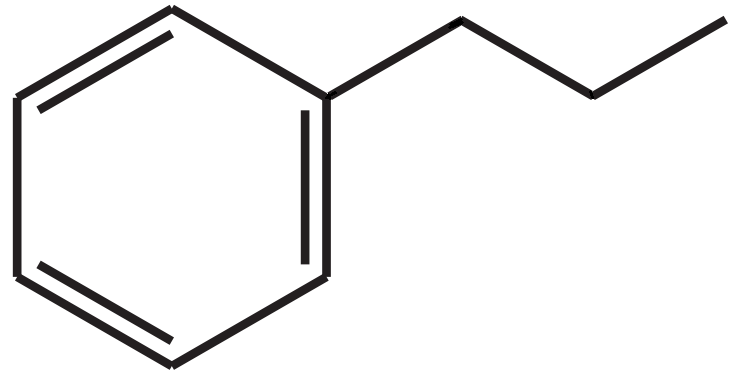
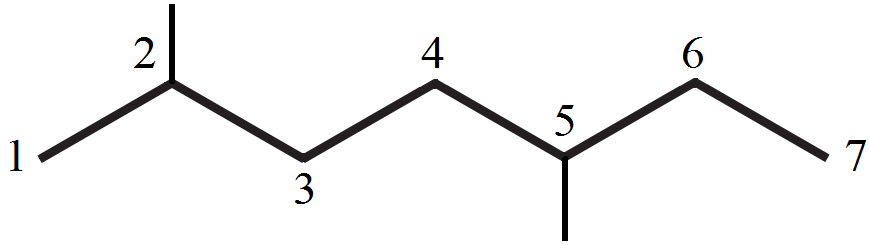
Write IUPAC names of the following:
  1.  

  1.  

  1.  

Answer

  1. Propyl benzene.
  2. 2, 5-Dimethyl heptanes.
  3. 3-Chloropropanal.

Need a full question paper?

Generate a complete, print-ready paper with questions like this in minutes — across 16+ boards, with answer keys.

Start Generating Free

Similar questions

Arrange the following according to bond length and bond dissociation energy giving reasons:
  1. $\text{H}-\text{F},\text{H}-\text{Cl},\text{H}-\text{Br},\text{H}-\text{I}$
  2. $\text{C}-\text{C},\text{C}=\text{C},\text{C}\equiv\text{C}$
  3. $\text{C}-\text{H}$ bond lenth in CH4, C2H4 and C2H2
Find energy of each of the photons which,
Have wavelength of 0.50 $\mathring{\text{A}}.$
Indicate the type of bonds present in NH4NO3 and state the mode of hybridisation of two N-atoms in it.
Among the elements B, Al, C and Si:
  1. Which element has the highest first ionisation enthalpy?
  2. Which element has the most metallic character? Justify your answer in each case.
1. At $298 K, K _{ p }$ for the reaction $N _2 O _4(g) \rightleftharpoons 2 NO _2(g)$ is 0.98 . Predict whether the reaction is spontaneous or not.
2. Define specific heat.
3. State Hess's law.
Arrange the following sets of molecules in the decreasing order of bond angle.
  1. SF6, CCl4, H2O, NH3
  2. CH4, NH3, H2O, BF3
For the following bond cleavages, use curved-arrows to show the electron flow and classify each as homolysis or heterolysis. Identify reactive intermediate produced as free radical, carbocation and carbanion.

  1. In the following redox reactions, identify the oxidation and reducing agents:
  1. $\text{H}_3\text{PO}\text{(aq)}+2\text{HgCl}_2+2\text{H}_2\text{O}\text{(aq)}\\ \xrightarrow{ \ \ \ \ }\text{H}_3\text{PO}_4\text{(aq)}+2\text{Hg(l)}+4\text{HCl(aq)}$

  2. $\text{O}_2\text{(g)}+\text{PtF}_6\text{g}\xrightarrow{ \ \ \ \ }\text{O}_2^+[\text{PtF}_6]^\ominus\text{(s)}$

  1. Why does H2S acts as reducing agent only whereas SO2 acts as bot oxidant as wells as rductant?

Neutral solutions have pH = 7 at 298K. A sample of pure water is found to have pH < 7. Does it mean that it is acidic? Explain.