Answer

(a) Taking a fixed mass of dinitrogen, say 28 gm , the mass of dioxygen that reacts with it to form oxide is $32,64,32$ and 80 respectively, whose simple ratio is $2: 4: 2: 5$ which is a simple integer ratio. Therefore, these data are in accordance with law of multiple proportion.
(b) (i) $\begin{aligned} 1 km=1 km \times \frac{1000 m}{1 km} \times \frac{100 cm}{1 m} & \times \frac{10 mm}{1 cm} \\ & =10^6 mm\end{aligned}$
$\begin{array}{l}1 km=1 km \times \frac{1000 m}{1 km} \times \frac{1 pm }{10^{-12} m}=10^{15} Pm \\ \text { Hence } 1 km=10^6 mm=10^{15} pm \end{array}$
(ii) $1 mg =\frac{1 mg \times 1 g}{1000 mg } \times \frac{1 kg}{1000 g}=10^{-6} kg$
$\begin{array}{l}1 mg =1 mg \times \frac{1 g}{1000 mg } \times \frac{1 ng }{10^{-9} g}=10^6 ng \\ \text { Hence } 1 mg =10^{-6} kg=10^6 ng \end{array}$
$\begin{array}{l}\text { (iii) } 1 mL=1 mL \times \frac{1 L}{1000 mL}=10^{-3} L \\ 1 mL=1 cm^3=1 cm^3 \times \frac{1 dm }{10 cm} \times \frac{1 dm }{10 cm} \\ \times \frac{1 dm }{10 cm}=10^{-3} dm ^3 \\ \text { Hence } 1 mL=10^{-3} L=10^{-3} dm ^3\end{array}$

Need a full question paper?

Generate a complete, print-ready paper with questions like this in minutes — across 16+ boards, with answer keys.

Start Generating Free

Similar questions

Write equation of following :
(i) Formation of ethyne from iodoform
(ii) Formation of but-2-yne from propyne with help of Grignard reagent
(iii) Addition of HBr with propyne in presence of peroxide
Match Cloumn I with Column II.
S. No
Cloumn I
S. No
Cloumn II
1.
88g of CO2
(i)
0.25mol
2.
6.022 × 1023 molecules of H2O
(ii)
2mol
3.
5.6 litres of O2 at STP
(iii)
1mol
4.
96g of O2
(iv)
6.022 × 1023 molecules
5.
1mol of any gas
(v)
3mol
Equilibrium constant, Kc for the reaction
$\text{N}_2\text{ (g) + 3H}_2\text{ (g)}\rightleftharpoons2\text{NH}_3\text{ (g) at 500k is 0.061}$
At a particular time, the analysis shows that composition of the reaction mixture is 3.0mol L–1 N2, 2.0mol L–1 H2 and 0.5mol L–1 NH3. Is the reaction at equilibrium? If not in which direction does the reaction tend to proceed to reach equilibrium?
Find out the value of Kc for each of the following equilibria from the value of Kp:
$2\text{CaCO}_3\text{ (S)}\rightleftharpoons\text{CaO(S) + CO}_2\text{ (g)};\text{ k}_{\text{p}}=167\text{ at }1073\text{K}$
Write characteristics of all seven periods of the periodic table.
An alkane has a molecular mass of 72. Give all the possible structural isomers along with their IUPAC names.
Some processes are given below. What happens to the process if it is subjected to a change given in the brackets?

  1.  

(Pressure is increased)

  1. Dissolution of NaOH in water (Temperature is increased.)
  2. $\text{N}_2(\text{g})+\text{O}_2(\text{g})\rightleftharpoons2\text{NO}(\text{g})-180.7\text{KJ}$ (Pressure is increased and temperature is decreased.)
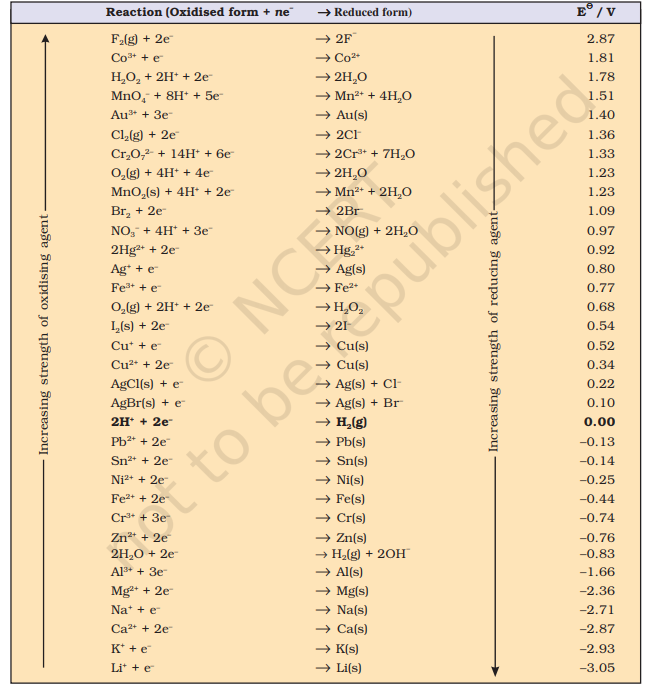
Using the standard electrode potentials given in the Table, predict if the reaction between the following is feasible:

Br2(aq) and Fe2+(aq).
Why does fluorine not show disporportionation reaction?
What do you understand by bond pairs and lone pairs of electrons? Illustrate by giving one exmaple of each type.