Question
  1. Write outer electronic configuration of Cr atom. Why are half filled orbitals more stable?
  2. An electron has a velocity of $50 \mathrm{~ms}^{-1}$, accurate upto $99.99 \%$. Calculate the uncertainty in locating its position. (Mass of electron $=9.1 \times 10^{-31} \mathrm{~kg}, \mathrm{~h}=6.6 \times 10^{-34} \mathrm{~J}$ s)
  3. Write the atomic number of the element in which filling of 3d sub-shell in the atom just starts.
Answer

  1. Cr(24): $1 s^2 2 s^2 2 p^6 3 s^2 3 p^6 4 s^1 3 d^5$
Half filled orbitals are more stable because of symmetrical distribution of electrons and exchange energy is maximum.
  1. $\Delta\text{V}=50\times\big[(100-99.99)\%\big]$
$=50\times\frac{0.01}{100}=50\times10^{-4}$
$=5\times10^{-3}\text{ms}^{-1}$
$\Delta\text{x}.\Delta\text{V}=\frac{\text{h}}{4\pi\text{m}}$
$\Delta\text{x}\times5\times10^{-3}\text{ms}^{-1}=\frac{6.6\times10^{-34}\text{Js}}{4\times3.142\times9\times10^{-31}\text{kg}}$
$\Rightarrow\Delta\text{x}=\frac{6.6\times10^{-34}\text{Js}}{4\times3.142\times9.1\times10^{-31}\text{kg}\times5\times10^{-3}\text{ms}^{-1}}$
$=1.154\times10^{-2}\text{m}$
  1. Scandium (Atomic number 21) is the element in which filling of 3d orbitals starts.

Need a full question paper?

Generate a complete, print-ready paper with questions like this in minutes — across 16+ boards, with answer keys.

Start Generating Free

Similar questions

Determine the molecular formula of an oxide of iron, in which the mass per cent of iron and oxygen are $69.9$ and $30.1$, respectively.
Note: Given that the molar mass of the oxide is $159.69g\ mol^{-1}$
Calculate the equilibrium constant for the following equilibrium system at 1120K. $\text{C}(\text{s})+\text{CO}_2(\text{g})+2\text{Cl}_2\stackrel{\text{K}_\text{p}}{\rightleftharpoons}2\text{COCl}_2(\text{g})$ Given the following equations and equilibrium constants: $\text{CO}(\text{s})+\text{Cl}_2(\text{g})\rightleftharpoons\text{COCl}_2(\text{g})$ $\text{Kp}_1 = 6.0 \times 10-3 \dots(1)$ $\text{CO}(\text{s})+\text{Cl}_2(\text{g})\rightleftharpoons\text{CO}_2(\text{g})$$\text{Kp}_2 = 1.3 \times 1014 \dots(2)$
The ionization constant of dimethylamine is $5.4 \times 10^{–4}$​​​​​​​. Calculate its degree of ionization in its $0.02M$ solution. What percentage of dimethylamine is ionized if the solution is also $0.1M$ in NaOH?
On the basis of quantum numbers, justify that the sixth period of the periodictable should have 32 elements.
  1. What is the increasing order of the acidity of the compounds, $H_2O, H_2S$ and $H$, Se? Give reason for your answer.
  2. Complete and balance the following chemical equations:
    1. $\text{Na}+\text{D}_2\text{O}\xrightarrow{\ \ \ \ \ \ \ \ \ \ }$
    2. $\text{SO}_3+\text{D}_2\text{O}\xrightarrow{\ \ \ \ \ \ \ \ \ \ \ }$
    3. $\text{Na}_2\text{O}+\text{D}_2\text{O}\xrightarrow{\ \ \ \ \ \ \ \ \ \ }$
What is Bond Enthalpy? Discuss in detail.
The ionization constant of benzoic acid is $6.46 \times 10^{–5}$ and $K_{sp}$ for silver benzoate is $2.5 \times 10^{–13}$. How many times is silver benzoate more soluble in a buffer of pH 3.19 compared to its solubility in pure water?
A compound on analysis found to contain following percentage composition:
$Na = 43.4\%, C = 11.4\%$ and $O = 45.3\%$. Determine the empirical and molecular formulae.
Given: the relative molecular mass of the compound is $106$.
Discuss the trend of the following:
The solubility and the nature of oxides, of Group 2 elements.
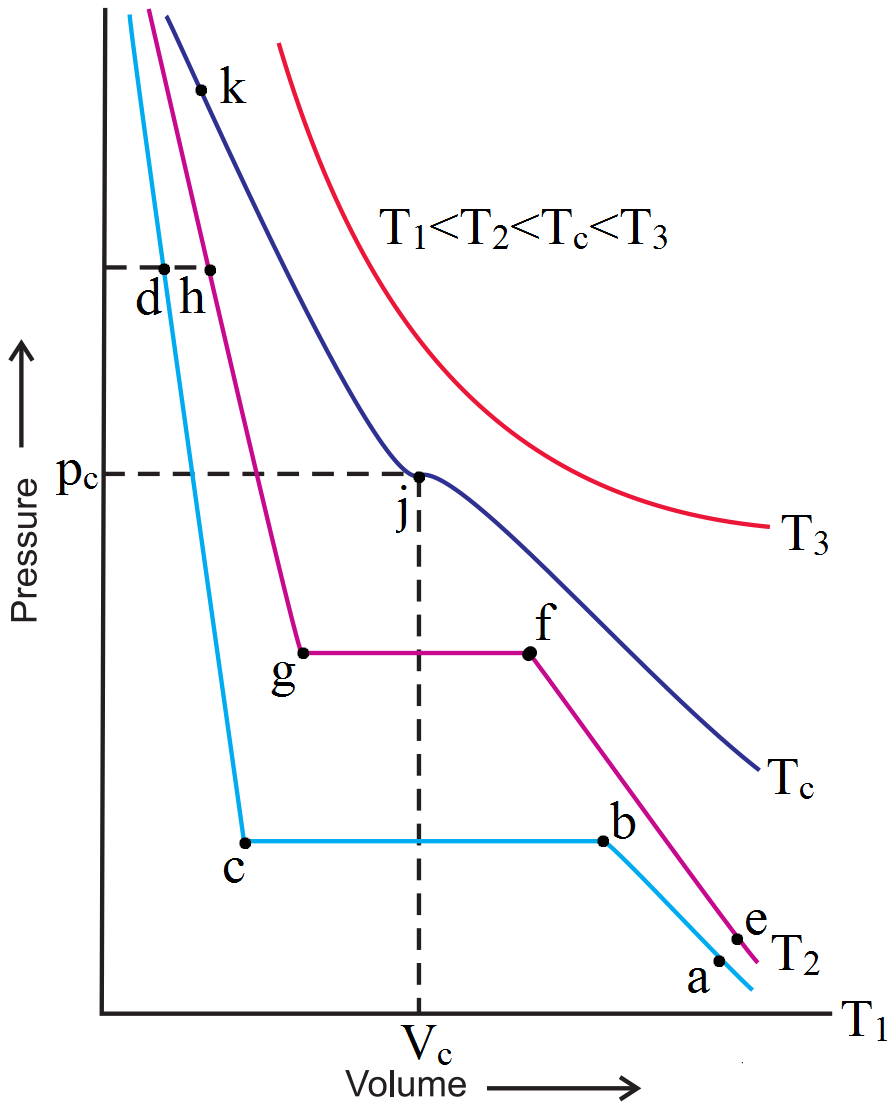
Isotherms of carbon dioxide at various temperatures are represented in the figure. Answer the following questions based on the figure.

i. In which state will $CO _2$ exist between the points a and b at temperature $T _1$ ?
ii. At what point will $CO _2$ start liquefying when temperature is $T _1$ ?
iii. At what point will $CO _2$ be completely liquefied when temperature is $T _2$ ?
iv. Will condensation take place when the temperature is $T_3$ ?
v. What portion of the isotherm at $T _1$ represent liquid and gaseous $CO _2$ at equilibrium?