Question
Write short note on the following:
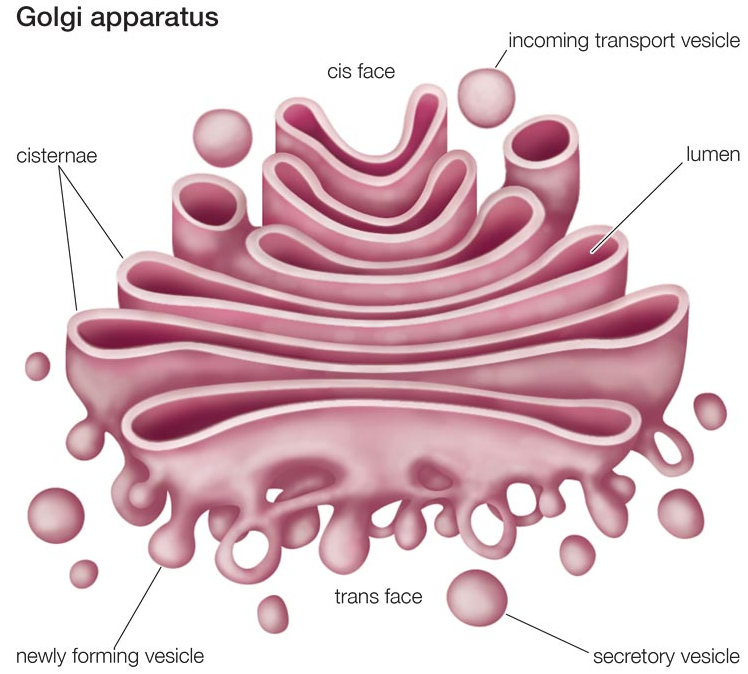
Golgi apparatus.
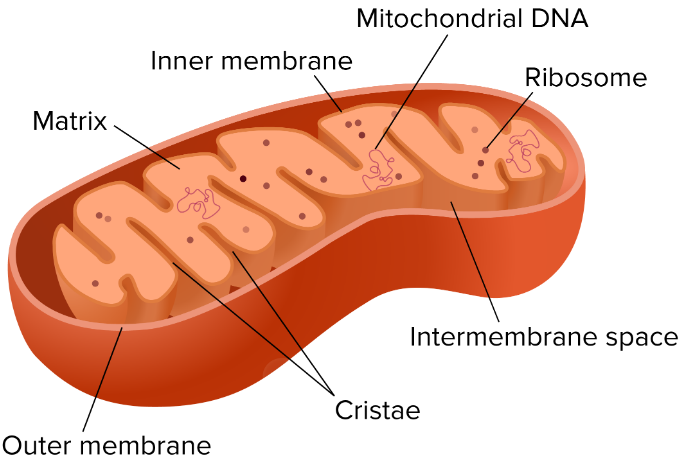
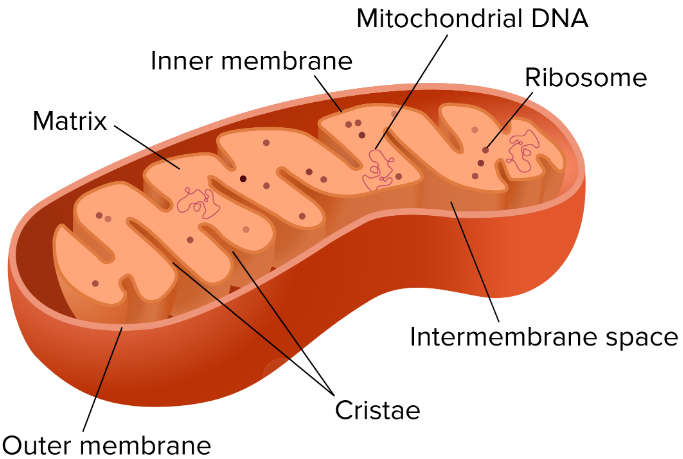
Mitochondria.

Answer

  1. Golgi apparatus consists of a set of membrane$-$bounded, fluid filled vesicles, vacuoles and flattened cisternae. Cisternae are usually stacked together $($placed one above the other$)$ in parallel rows. Golgi apparatus exists as an extensive network near the nucleus in the animal cells. However, the plant cells contain many freely distributed subunits of Golgi apparatus, called dictyosomes.
The Golgi apparatus arises from the membrane of the smooth endoplasmic reticulum, which in turn originates from the rough endoplasmic reticulum.
  1. The mitochondria are tiny bodies of varying shapes and size. Each mitochondria is bounded by a double membrane envelope. Outer membrane is porous. The inner membrane is thrown into folds. These folds are called cristae and are studded with small rounded bodies known as $F_{1 }$ particles or oxysomes. The interior cavity of the mitochondria is filled with a proteinaceous matrix which contains a few small$-$sized ribosomes, a circular $ \text{DNA}$ molecule and phosphate granules. Mitochondria are sites of cellular respiration.

Need a full question paper?

Generate a complete, print-ready paper with questions like this in minutes — across 16+ boards, with answer keys.
Start Generating Free

Similar questions

What are the different means by which infectious diseases are spread?
How will you separate a mixture containing kerosene and petrol (difference in their boiling points is more than $25^\circ\ C$), which are miscible with each other?
A farmer is advised to use manure instead of fertilizer in his fields. List any two advantages that the farmer will get if he accepts this advice. How is the use of manure particularly useful for clayey and sandy soil?
Iron powder and sulphur powder were mixed together and divided into two parts $A$ and $B$. When part $A$ was heated strongly over a burner, then a substance $C$ was formed. The part $B$ was, however, not heated at all. When dilute hydrochloric acid was added to substance $C$, then gas $D$ was evolved and when dilute hydrochloric acid was added to part $B$ then gas $E$ was evolved.
  1. What type of substance is $B$?
  2. What type of substance is $C$?
  3. Name the gas (i) $D,$ and (ii) $E$?
  4. Write one characteristic property of gas $D$.
Why are we able to sip hot tea or milk faster from a saucer rather than from a cup?
A truck of mass $M$ is moved under a force $F.$ If the truck is then loaded with an object equal to the mass of the truck and the driving force is halved, then how does the acceleration change?
i. Describe the role played by the lysosomes. Why are they termed as suicidal bags? How do they perform their function?
ii. What happens to the dry raisins, when placed in plain water for some time? State the reason for whatever is observed. What would happen if these raisins are then placed in concentrated salt solution?
What is irrigation? Discuss the various methods of irrigation.
Write the main functions of atleast ten cell components.
State the various postulates of Dalton’s atomic theory of matter.