Question
Write short note :
Structure of the Modern Periodic table.

Answer

(i) The Modern Periodic table contains seven horizontal rows called the periods 1 to 7.
(ii) Similarly, the eighteen vertical columns are the groups 1 to 18.
(iii) The arrangement of the periods and groups results into formation of boxes.
(iv) Atomic numbers are serially indicated in the upper part of these boxes.
(v) Each box corresponds to the place for one element.
(vi) Apart from these seven rows, two rows are shown separately at the bottom of the periodic table.
(vii) These are called Lanthanide series and Actinide series respectively.
(viii) There are 118 boxes in the periodic table including the two series.
(ix) It means that there are 118 places for elements in the Modern Periodic table.
(x) The Modern Periodic table is now completely filled means all the 118 elements are now discovered.
(xi) The entire periodic table is divided into four blocks, viz, s-block, p-block, d-block and f-block.
(xii) The s-block contains the groups 1 and 2 elements.
(xiii) The groups 13 to 18 constitute the p-block elements.
(xiv) The groups 3 to 12 constitute the d-block elements. The d-block elements are called transition elements.
(xv) The lanthanide and actinide series at the bottom form the f-block elements.
(xvi) A zig-zag line can be drawn in the p-block of the periodic table.
(xvii) The metalloid elements lie along the border of this zig-zag line.
(xviii) All the metals lie on the left side of the zig-zag line, while all the non-metals lie on the right side.
Need a full question paper?

Generate a complete, print-ready paper with questions like this in minutes — across 16+ boards, with answer keys.

Start Generating Free

Similar questions

When a person puts food in his mouth, then teeth cut it into small pieces, chew and grind it. The glands A in the mouth secrete a substance B which is mixed with the food by tongue. The substance B contains an enzyme C which starts the digestion of food in the mouth. The slightly digested food from the mouth goes down a tube D. The special type of movements E in the walls of tube D push the food into stomach for further digestion. The stomach wall secretes gastric juice containing three substance F, G and H. One of the functions of F is to kill bacteria which may enter the stomach with food. The substance G protects the inside layer of stomach from the damaging effect of substance F whereas substance H is and enzyme for digestion. The partially digested food then enters into small intestine for further digestion.
  1. What is Gland A, Substance B and Enzyme C?
  2. Name the tube D.
  3. What is the movement E known as?
  4. What are F, G and H?
The organisms A, B and C can obtain their food in three different ways. Organism A derives its food from the body of another living organism which is called its D, without killing it. The organism B takes in the solid food by the process of ingestion, digests a part of this food and throws out undigested food in the process called E. The organism C obtains its food from dead and decaying plants.
  1. What is the mode of nutrition of (i) organism A (ii) organism B, and (iii) organism C?
  2. What is the organism like D called?
  3. Name the process E.
  4. Give one example each of organisms like A, B and C.
  5. What is the general name of three modes of nutrition exhibited by organisms A, B and C?
When a person eats sugary food, then organisms A present in his mouth act on sugar to produce a substance B. The substance B first dissolves the calcium salts from the top part C of the tooth and then from its middle part D forming holes E. These holes ultimately reach the part F in the lower part of tooth which contains nerves and blood vessels. The substance B irritates the nerve endings inside the tooth causing toothache.
  1. What are (i) organisms A, and (ii) substance B?
  2. What are (i) part C, and (ii) part D, of tooth known as?
  3. By what name are the holes E in the tooth known?
  4. Name the part F of the tooth.
  5. What will happen if organisms A reach part F of the tooth known?
Write short note: Benefits of classification.
What is esterification and give its uses?
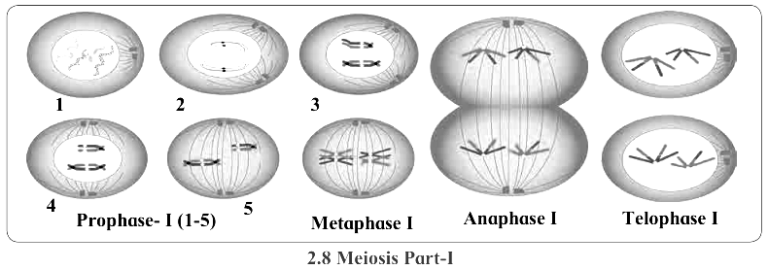
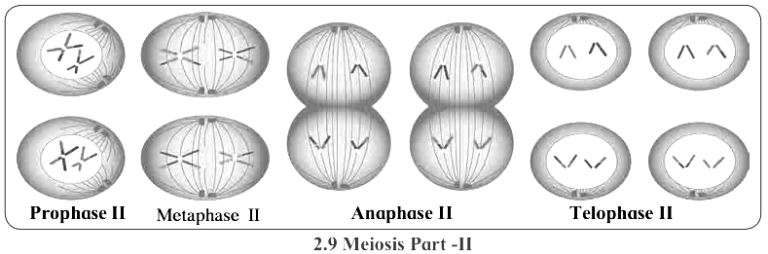
Observe the diagrams and answer the following questions.
Image
Image

(a) Which peculiarity do you observe in the figure of Metaphase-I of meiosis ?
(b) What is the important difference between Telophase-I and Telophase-II of meiosis?
(c) Which figure shows phenomena of crossing over?
Explain the statement – ‘We have got this Earth planet on lease from our future generations and not as an ancestral property from our ancestors.’
In a Std. X class, out of 40 students, 10 students use spectacles, 2 students have ( positive power and 8 students have negative power of lenses in their spectacles.
Answer the following questions:
(1) What does the negative power indicate?
(2) What does the positive power indicate?
(3) Generally which type of spectacles do most of the students use?
(4) What defect of eyesight do most of the students suffer from?
(5) Give two possible reasons for the above defect.
What are the different types of tropisms? Define each type of tropism. Write the name of stimulus in each case.
State the general properties of ionic compounds.
###
Write any three general properties of ionic compounds.