Question
Write the applications of d- and f-block elements.

Answer

self

Need a full question paper?

Generate a complete, print-ready paper with questions like this in minutes — across 16+ boards, with answer keys.

Start Generating Free

Similar questions

Explain with two examples each of the following coordination entity, ligand coordination number, coordination polyhedron, homoleptic and heteroleptic.
Why is it not possible to obtain pure ethanol by fractional distillation? What general name is given to binary mixtures which show deviation from Raoult’s law and whose components cannot be separated by fractional distillation. How many types of such mixtures are there?
(a) Give plausible explanation for each of the following:
i. Why are amines less acidic than alcohols of comparable molecular masses?
ii. Why are primary amines highest boiling than tertiary amines?
iii. Why are aliphatic amines stronger bases than aromatic amines?
(b) Complete the following reactions:
i. $C _6 H _5 N_2 Cl + C _2 H _5 OH \rightarrow$
ii. $C _6 H _5 NH _2+\left( CH _3 CO \right)_2 O \rightarrow$
Match the property given in Column I with the element given in Column II.
 
Column I (Property)
 
Column II (Element)
(i)
Lanthanoid which shows +4 oxidation state
(a)
Pm
(ii)
Lanthanoid which can show +2 oxidation state
(b)
Ce
(iii)
Radioactive lanthanoid
(c)
Lu
(iv)
Lanthanoid which has 4felectronic configuration in +3 oxidation state
(d)
Eu
(v)
 Lanthanoid which has 4f14 electronic configuration in +3 oxidation state
(e)
Gd
 
 
(f)
Dy
An organic compound contains $69.77 \%$ carbon, $11.63 \%$ hydrogen and rest oxygen. The molecular mass of the compound is 86 . It does not reduce Tollens' reagents but forms an addition compound with sodium hydrogen sulphite and give positive iodoform test on vigorous oxidation it gives ethanoic and propanoic acid. Write the possible structure of the compound.
Attempt any five of the following:
(a) Deficiency of which vitamin causes night-blindness.
(b) Give two examples of reducing sugars.
(c) Define the following terms:
   i. Glycosidic linkage
  ii. Native protein
(d) Write function of carbohydrates in plants.
(e) Differentiate between:
  i. Peptide linkage and Glycosidic linkage
  ii. Nucleoside and Nucleotide
(f) What type of linkage holds together the monomers of DNA?
(g) Write the product obtained when D-glucose reacts with H2N-OH.
How will you convert ethyl bromide into:
(i) ethane, (ii) butane, (iii) propanoic acid, and (iv) ethoxyethane?
Match the terms given in Column I with the units given in Column II.

 
Column I


Column II

i.

$\wedge_{\text{m}}$

a.

Intensive property.

ii.

$\text{E}^{\ominus}_{\text{Cell}}$

b.

Depends on number of ions/volume.

iii.

$\text{K}$

c.

Extensive property.

iv.

$\Delta_{\text{r}}\text{G}_{\text{Cell}}$

d.

Increases with dilution.

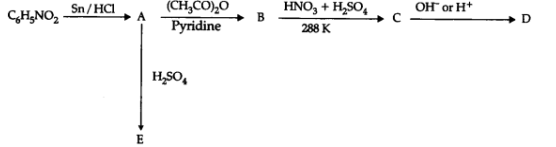
Write the structure of A, B, C, D and E in the following reactions:
Image
Two elements A and B form compounds having formula AB2 and AB4. When dissolved in 20 g of benzene $\left( C _6 H _6\right), 1 g$ of $AB _2$ lowers the freezing point by 2.3 K whereas 1.0 g of AB4 lowers it by 1.3 K. The molar depression constant for benzene is 5.1 K kg mol-1. Calculate atomic masses of A and B.