Question
Write the difference between parallel combination and series combination of capacitors.

Answer

(1) Such a combination of capacitors in which the value of potential difference on each capacitor is equal, is called parallel combination. Such a combination of capacitors, in which the magnitude of charge on each capacitor remains the same, is called a series combination.
(2) Combination of capacitors by connecting them in parallel, equivalent capacitance is equal to the sum of the capacitances of each capacitor. In series combination, the reciprocal of the equivalent capacitance of the circuit is equal to the sum of the reciprocals of the capacitance of each capacitor used in this combination.
The value of equivalence obtained in series combination is less than the value of any capacitance.
Need a full question paper?

Generate a complete, print-ready paper with questions like this in minutes — across 16+ boards, with answer keys.

Start Generating Free

Similar questions

Write down the difference between series and parallel connection of capacitors
Electrons are emitted from an electron gun at almost zero velocity and are accelerated by an electric field E through a distance of 1.0m. The electrons are now scattered by an atomic hydrogen sample in ground state. What should be the minimum value of E so that red light of wavelength 656.3nm may be emitted by the hydrogen?
Two heating coils, one of fine wire and other of thick wire, made of the same material and of the same length are connected one by one to a source of electricity. Which coil will produce heat at a greater rate?
The two rails of a railway track, insulated from each other and from the ground, are connected to a millivoltmeter. What will be the reading of the millivoltmeter when a train travels on the track at a speed of 180km/h-1? The vertical component of earth's magnetic field is 0.2 × 10⁻⁴ T and the rails are separated by 1m.
Write and explain Ampere's circuital law.
Explain ray of light and beam of light.
The $\text{K}_\beta$ X-ray of argon has a wavelength of 0.36nm. The minimum energy needed to ionize an argon atom is 16eV. Find the energy needed to knock out an electron from the K shell of an argon atom.
Show that the radius of the orbit in hydrogen atom varies as n2, where n is the principal quantum number of the atom.
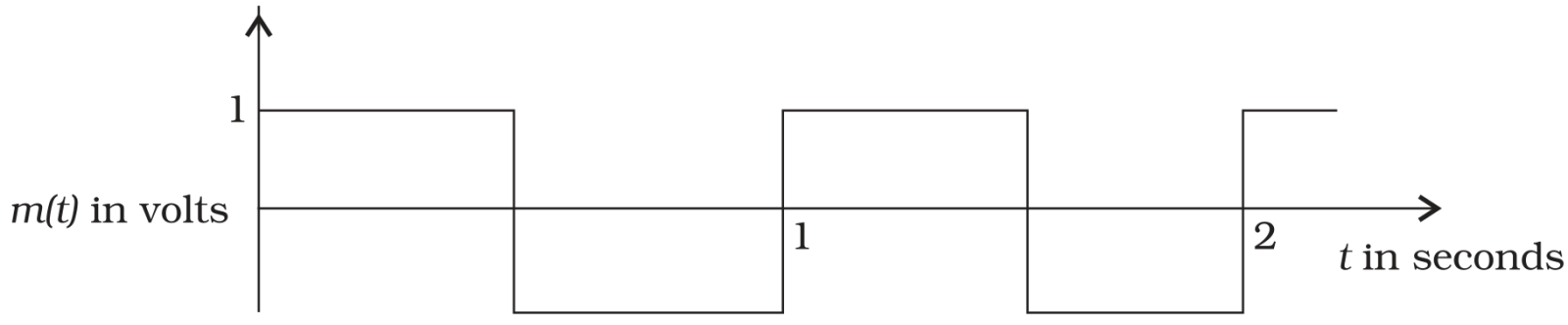
A modulating signal is a square wave, as shown in Fig.

The carrier wave is given by c(t) = 2sin (8$\pi$t) volts.

  1. Sketch the amplitude modulated waveform,
  2. What is the modulation index?
What are ohmic and non-ohmic resistances? Write down one example of both.