Question
Write the expression for the force on a charge moving in a magnetic field.

Use this expression to define the SI unit of magnetic field.

Answer

Force on a charge (q) moving in a magnetic field B with velocity $\vec{\text{v}}$ making an angle $\theta$ (with the direction of magnetic field $(\vec{\text{B}})$ is given by,

$\text{F}_\text{m}=\text{qvB}\sin\theta$

when $\theta=90^\circ\Rightarrow\sin\theta=1,$so
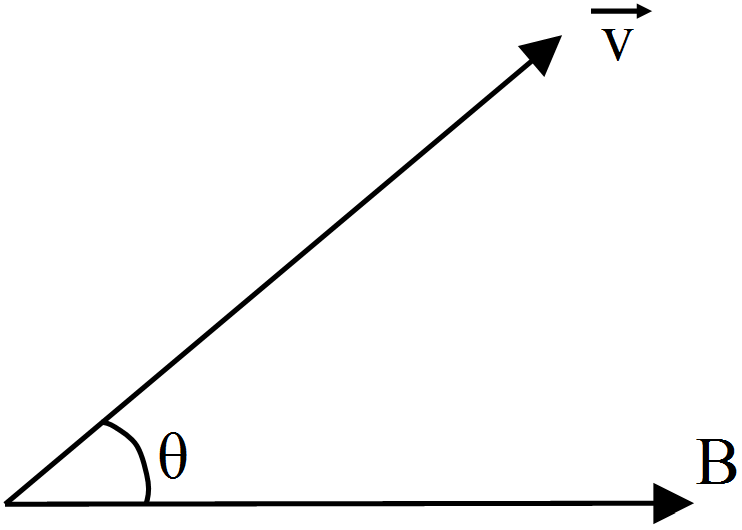
$\text{F}_\text{m}=\text{qvB}$

$\text{or}\ \text{B}=\frac{\text{F}_\text{m}}{\text{q}^\text {v}}$

$\text{If}\ \text{v}=1\ \text{m/s},\text{B}=\frac{\text{F}_\text{m}}{\text{q}}\ \text{newton/ coulomb}$

SI unit of magnetic field is telsa.

Thus, 1 tesla is the magnetic field in which a charged particle moving with velocity 1m/ s perpendicular to velocity experiences a force of 1 newton/ coulomb.

Need a full question paper?

Generate a complete, print-ready paper with questions like this in minutes — across 16+ boards, with answer keys.

Start Generating Free

Similar questions

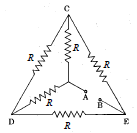
  1. Calculate the equivalent resistance of the given electrical network between points A and B.
  2. Also calculate the current through CD and ACB, if a 10 V d.c. source is connected between A and B, and the value of R is assumed as 2 Ω.

  1. Three resistors $2\ \Omega,\ 4\ \Omega\ \text{and}\ 5\ \Omega$ are combined in parallel. What is the total resistance of the combination?
  2. If the combination is connected to a battery of emf 20 V and negligible internal resistance, determine the current through each resistor, and the total current drawn from the battery.
A swimmer wishes to cross a 500m wide river flowing at 5km/h. His speed with respect to water is 3km/h.
  1. If he heads in a direction making an angle 0 with the flow, find the time he takes to cross the river.
  2. Find the shortest possible time to cross the river.
A long straight wire in the horizontal plane carries a current of 50 A in north to south direction. Give the magnitude and direction B at a point 2.5 m east of the wire.
The. wire ABC shown in figure forms an equilateral triangle. Find the magnetic field B at the centre O of the triangle assuming the wire to be uniform.

Two particles have equal masses of 5.0g each and opposite charges of +4.0 × 10-5 C and -4.0 × 10-5C. They are released from rest with a separation of 1.0m between them. Find the speeds of the particles when the separation is reduced to 50cm.
A electron of mass me revolves around a nucleus of charge +Ze. Show that it behaves like a tiny magnetic dipole. Hence prove that the magnetic moment associated wit it is expressed as $\vec\mu=-_{e2{\text{ me}}}\overrightarrow{\text{L}}$, where $\overrightarrow{\text{L}}$ is the orbital angular momentum of the electron. Give the significance of negative sign.
  1. Draw a graph showing variation of photocurrent with anode potential for a particular intensity of incident radiation. Mark saturation current and stopping potential.
  2. By how much would the stopping potential for a given photosensitive surface go up if the frequency of the incidentradiations were to be increased from $4\times10^{15}\text{ }\text{Hz}\text{ }\text{to}8\text{ }\times10^{15}\text{ }\text{Hz}$?
Explain how resistance of conductor depends on the dimension of the conductor and derive its equation.
A proton is projected with a velocity of 3 × 10⁶ ms-1 perpendicular to a uniform magnetic field of 0.6T. Find the acceleration of the proton.