Question
Write the expression for the force on a charge moving in a magnetic field.Use this expression to define the SI unit of magnetic field.
Answer

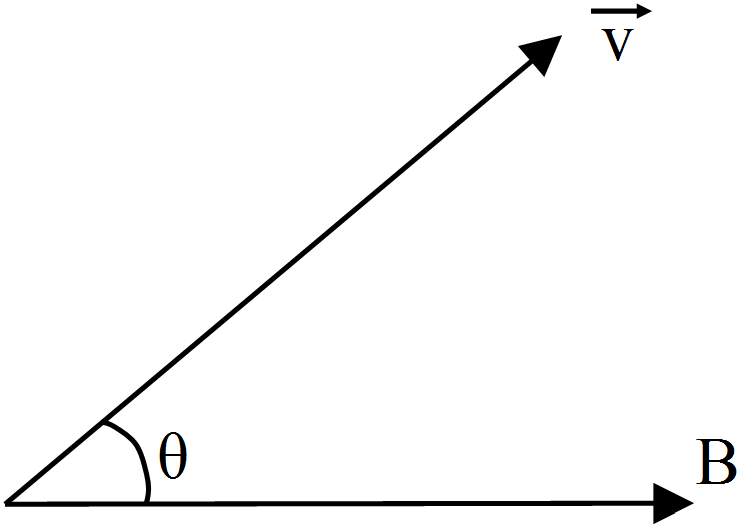
Force on a charge (q) moving in a magnetic field B with velocity $\vec{\text{v}}$ making an angle $\theta$ (with the direction of magnetic field $(\vec{\text{B}})$ is given by,$\text{F}_\text{m}=\text{qvB}\sin\theta$
when $\theta=90^\circ\Rightarrow\sin\theta=1,$so

$\text{F}_\text{m}=\text{qvB}$
$\text{or}\ \text{B}=\frac{\text{F}_\text{m}}{\text{q}^\text {v}}$
$\text{If}\ \text{v}=1\ \text{m/s},\text{B}=\frac{\text{F}_\text{m}}{\text{q}}\ \text{newton/ coulomb}$
SI unit of magnetic field is telsa.
Thus, 1 tesla is the magnetic field in which a charged particle moving with velocity 1m/ s perpendicular to velocity experiences a force of 1 newton/ coulomb.

Need a full question paper?

Generate a complete, print-ready paper with questions like this in minutes — across 16+ boards, with answer keys.

Start Generating Free

Similar questions

Three capacitors of capacitance 2 pF, 3 pF and 4 pF are connected in parallel.
(a) What is the total capacitance of the combination?
(b) Determine the charge on each capacitor if the combination is connected to a 100 V supply.
C1 = 2 pF
= 2 X 10 -12 F
C2 = 3 pF
3 X 10 -12 F
C3 = 4 pF
= 4 X 10-12 F
The product of the hole concentration and the conduction electron concentration turns out to be independent of the amount of any impurity doped. The concentration of conduction electrons in germanium is $6 \times 10^{19 }$ per cubic metre. When some phosphorus impurity is doped into a germanium sample, the concentration of conduction electrons increases to $2 \times 10^{23}$ per cubic metre. Find the concentration of the holes in the doped germanium.
  1. Drive the expression for electric field at a point on the equatorial line of an electric dipole.
  2. Depict the orientation of the dipole in (i) stable, (ii) unstable equilibrium in a uniform electric field.
A wire of length 1m and radius 0.1mm has a resistance of $100\Omega.$ Find the resistivity of the material.
The following data was recorded for values of object distance and the corresponding values of image distance in the experiment on study of real image formation by a convex lens of power +5D. One of these observations is incorrect. Identify this observation and give reason for your choice:
S .No
Object distance (cm)
Image distance (cm)
1
25
97
2
30
61
3
35
37
4
45
35
5
50
32
6
55
30
$\text{ }^{197}_{80}\text{Hg}$ decay to $\text{ }^{197}_{79}\text{Au}$ through electron capture with a decay constant of 0.257 per day.
  1. What other particle or particles are emitted in the decay?
  2. Assume that the electron is captured from the K shell. Use Moseley's law $\sqrt{\text{v}}=\text{a(Z}-\text{b})$ with $\text{a}=4.95\times10^7\text{s}^{-\frac{1}{2}}$ and b = 1 to find the wavelength of the $\text{K}_{\alpha}$ X-ray emitted following the electron capture.
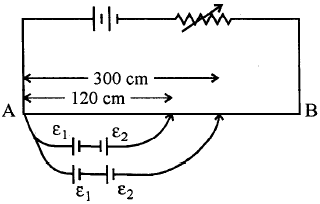
In the figure a long uniform potentiometer wire $AB$ is having a constant potential gradient along its length. The null points for the two primary cells of emfs $\varepsilon_{1}$ and $\varepsilon_{2}$
connected in the manner shown are obtained at a distance of $120 \ cm $ and $300 \ cm$ from the end $A$.
Find $(i) \varepsilon_{1} / \varepsilon_{2}$ and $(ii)$ position of null point for the cell $\varepsilon_{1}$. How is the sensitivity of a potentiometer increased?
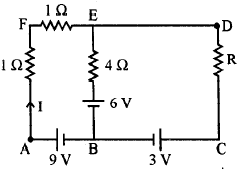
Using Kirchoffs rules determine the value of unknown resistance $R$ in the circuit so that no current flows through 4 $\Omega$ resistance. Also find the potential difference between $A$ and $D.$
Explain (i) forward biasing, (ii) reverse biasing of a P-N junction diode. With the help of a circuit diagram, explain the use of this device as a half-wave rectifier.
n-identical cells, each of emf $\varepsilon,$ internal resistance r connected in series are charged by a dc source of emf $\varepsilon'$ using a resistance R.
  1. Draw the circuit arrangement.
  2. Deduce expressions for (a) the charging current and (b) the potential difference across the combination of cells.
Which wavelengths will be emitted by a sample of atomic hydrogen gas (in ground state) if electrons of energy 12.2eV collide with the atoms of the gas?