Question
Write the expression, in a vector form, for the Lorentz magnetic force$\overrightarrow{\text{F}}$ due to a charge moving with velocity $\overrightarrow{\text{V}}$in a magnetic field $\overrightarrow{\text{B}}.$  What is the direction of the magnetic force?
Answer

$\overrightarrow{\text{F}} = \text{q}( \overrightarrow{\text{v}}\times\overrightarrow{\text{B}})$
Perpendicular to the plane formed by$\overrightarrow{\text{v}}$and $\overrightarrow{\text{B}}/\overrightarrow{\text{F}}\bot\overrightarrow{\text{v}}\text{and }\overrightarrow{\text{F}}\bot \overrightarrow{\text{B}}.$

Need a full question paper?

Generate a complete, print-ready paper with questions like this in minutes — across 16+ boards, with answer keys.

Start Generating Free

Similar questions

When a current of 2 A is passed through a coil, then magnetic flux of magnitude 40 milli $W b$ is obtained. What is self-induction of the coil?
The work functions of two metals A and B are 2 eV and 4 eV respectively. Whose threshold wavelength for photoelectric effect will be lower?
Can a battery be charged with alternating current?
Is the ratio of frequencies of ultraviolet rays and infrared rays in glass more than, less than or equal to 1?
A metal block of density 6000kg m-3 and mass 1.2kg is suspended through a spring of spring constant 200N m-1. The spring-block system is dipped in water kept in a vessel. The water has a mass of 260g and the block is at a height 40cm above the bottom of the vessel. If the support to the spring is broken, what will be the rise in the temperature of the water. Specific heat capacity of the block is 250Jkg-1 K-1 and that of water is 4200Jkg-1 K-1. Heat capacities of the vessel and the spring are negligible.
What is the average number of neutrons obtained per nucleus from the fission of uranium nucleus?
On what conservation laws are Kirch off's first and second laws based?
What is the luminous flux of a source emitting radio waves?
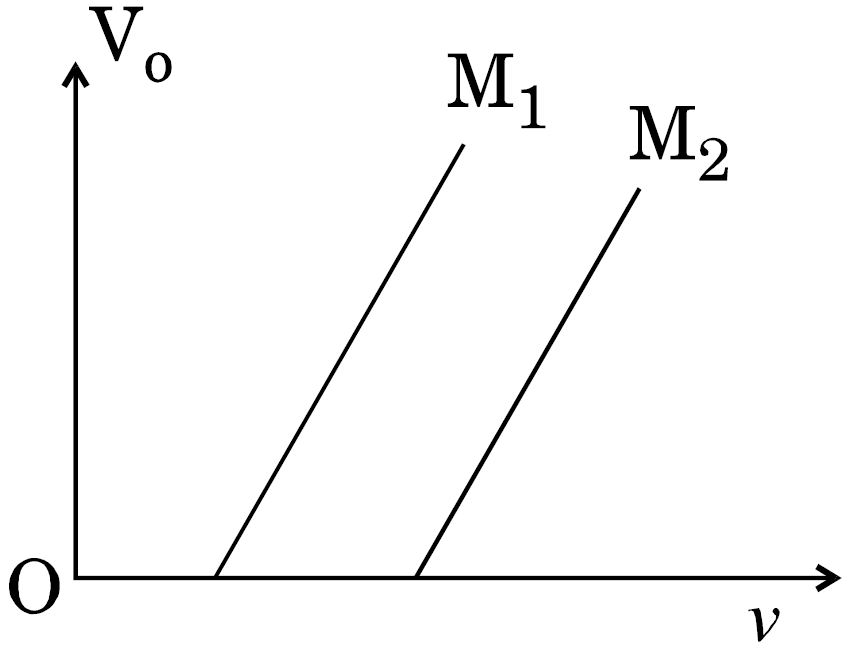
The variation of the stopping potential (V0) with the frequency (v) of the light incident on two different photosensitive surfaces M1 and M2 is shown in the figure. Identify the surface which has greater value of the work function.

Is work done by a battery always equal to the thermal energy developed in electrical circuit? What happens if a capacitor is connected in the circuit?