Question
Write the formulas for the following coordination compounds:
a. Tetraammineaquachloridocobalt(III) chloride
b. Potassium tetrahydroxidozincate(II)
c. Potassium trioxalatoaluminate(III)
d. Dichloridobis(ethane-1, 2-diamine)cobalt(III)
e. Tetracarbonylnickel(0)
Answer

a. The formula of Tetraammineaquachloridocobalt(III) chloride is $\left[ Co \left( NH _3\right)_4\left( H _2 O \right) Cl ^2\right) Cl _2$.
b. The formula of Potassium tetrahydroxidozincate(II) is $K _2\left[ Zn ( OH )_4\right]$.
c. The formula of potassium trioxalatoaluminate(III) is $K _3\left[ Al \left( C _2 O _4\right)_3\right]$.
d. The formula of Dichloridobis(ethane-1, 2-diamine)cobalt(III) is $\left[ CoCl _2( en )^2\right]^{+}$.
e. The formula of Tetracarbonylnickel $(0)$ is $\left[ Ni ( CO )_4\right]$.

Need a full question paper?

Generate a complete, print-ready paper with questions like this in minutes — across 16+ boards, with answer keys.

Start Generating Free

Similar questions

Explain the method of preparing haloalkanes by free radical substitution of alkanes.
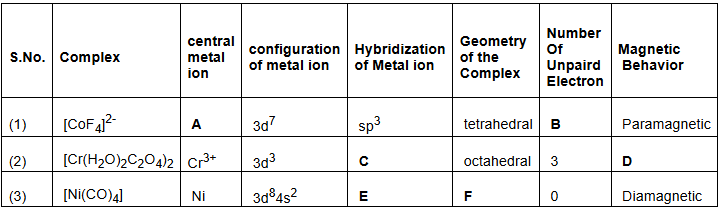
$(a).$ Using, Valence Bond Theory identify $\ce{A, B, C, D, E}$ and $\ce{F}$ in the following table$:$​​​​​​​
Image
$(b).$ Write the ionic equations for the reaction of acidified $\ce{K_2Cr_2O_7}$ with
$\ce{(i) H_2S}$ and $\ce{(ii) FeSO_4}​​​​​​​$​​​​​​​
$\ce{COSO_4Cl.5NH_3}$ exists in two isomeric forms $‘A’$ and $‘B’$. Isomer $‘A’$ reacts with $\ce{AgNO_3}$ to give white precipitate, but does not react with $\ce{BaCl_2.}$ Isomer $‘B’$ gives white precipitate with $\ce{BaCl_2} $ but does not react with $\ce{AgNO_3}$. Answer the following questions.
  1. Identify $‘A’$ and $‘B’$ and write their structural formulas.
  2. Name the type of isomerism involved.
  3. Give the $\text{IUPAC}$ name of $‘A’$ and $‘B’.$
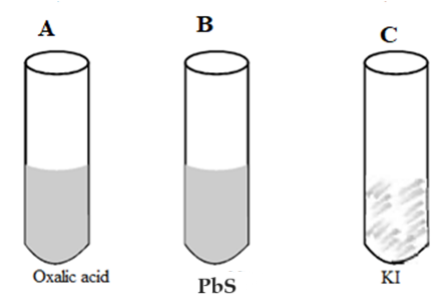
$(a).$ A purple colour compound $A,$ which is a strong oxidising agent and used for bleaching of wool, cotton, silk and other textile fibres was added to each of the three test tubes along with $H_2SO_4.$ It was followed by strong heating.
Image
In which of the above test tubes; $A, B$ or $C:$
$(i)$ Violet vapours will be formed
$(ii)$ The bubbles of gas evolved will extinguish a burning matchstick. Write an equation for each of the above observations.
$b. A$ metal ion $M^{n+}$ of the first transition series having $d^5$ configuration combines with three didentate ligands. Assuming $\Delta_0 < P:$
$(i)$ Draw the crystal field energy level diagram for the $3d$ orbital of this complex.
$(ii)$ What is the hybridisation of Mnt in this complex and why?
$(iii)$ Name the type of isomerism exhibited by this complex.
Describe the nucleophilic addition- elimination reactions of carbonyl compounds with reference to their reaction with the following compounds:
(i) Alcohol and thio alcohol
(ii) Ammonia and its derivatives
Explain the various methods of determining the order of a reaction.
Show how each of the following compounds can be converted into benzoic acid ?
(i) Ethylbenzene
(ii) Acetophenone
(iii) Bromobenzene
(iv) Phenylethene (Styrene)
Answer the following questions:
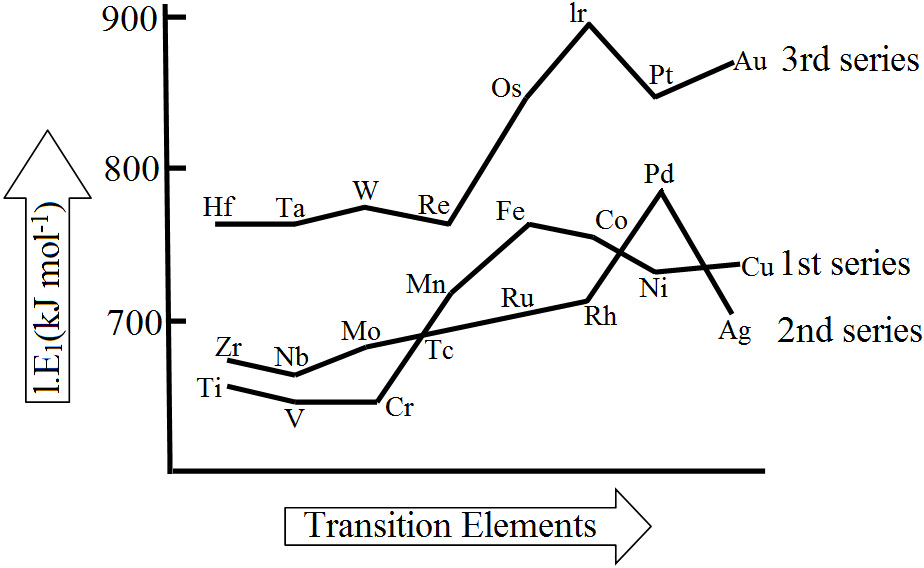
  1. The figure given alongside illustrates the first ionization enthalpies of first, second and third series of transition elements. Answer the question that follows:
  2. Which series amongst the first, second and third series of transition elements have the highest first ionization enthalpy and why?
  3. Separation of lanthanoid elements is difficult. Explain.
  4. $Sm^{2+}, Eu^{2+}$ and $Yb^{2+}$ ions in solutions are good reducing agents but an aqueous solution of $Ce^{4+}$ is a good oxidising agent. Why?
Attempt any five of the following:
(a) What is the structural feature characterising reducing sugars?
(b) What type of linkage is present in polysaccharides?
(c) Give examples of fat soluble vitamins.
(d) The two strands in DNA are not identical but are complementary. Explain.
(e) Write uses of B-Complex.
(f) Name the disaccharide which on hydrolysis gives two molecules of glucose.
(g) Name purines present in DNA?
Write difference between Phenol and Alcohol.