Question
Write the reactions taking place at the anode and cathode in the above cell.

Answer

Inert electrodes:
Anode: $2\text{H}_2\text{O}(\text{l})\xrightarrow{ \ \ \ \ \ \ \ }\text{O}_2(\text{g})+4\text{H}^{+}(\text{aq})+4\text{e}^-$
Cathode: $\text{Ag}^{+}(\text{aq})+\text{e}^-\xrightarrow{\ \ \ \ \ \ \ }\text{Ag(s)}$

Need a full question paper?

Generate a complete, print-ready paper with questions like this in minutes — across 16+ boards, with answer keys.

Start Generating Free

Similar questions

  1. How would you account for the following:
  1. Actinoid contraction is greater than lanthanoid contraction.
  2. Transition metals form coloured compounds.
  1. Complete the following equation:

$\text{2MnO}_{4}^{-}+\text{6H}^{+}+\text{5NO}_{2}^{-}\rightarrow$
Account for any two of the following:
  1. Amines are basic substances while amides are neutral.
  2. Nitro compounds have higher boiling points than the hydrocarbons having almost the same molecular mass.
  3. Aromatic amines are weaker bases than aliphatic amines.
While filling up of electrons in the atomic orbitals, the 4s orbital is filled before the 3d orbital but reverse happens during the ionisation of the atom. Explain why?
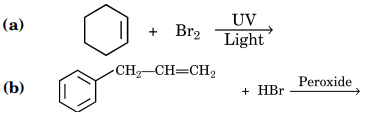
Write the major monohalo product(s) in each of the following reactions :
Image
The electrical resistance of a column of 0.05 M KOH solution of diameter 1 cm and length 45·5 cm is 4.55 $\times$ 103 ohm. Calculate its molar conductivity.
Estimate the minimum potential difference needed to reduce Al2O3 at 500°C. The free energy change for the decomposition reaction,
$\frac{2}{3}\text{Al}_2\text{O}_3\frac{4}{3}\text{Al + O}_2\text{ is }960\text{kJ (F = 96500C mol}-1)$
Match the items of column I with items of column II.
 
Column I
 
Column II
(i)
Methanol
(a)
Conversion of phenol to o-hydroxysalicylic acid
(ii)
Kolbe’s reaction
(b)
Ethyl alcohol
(iii)
Williamson’s synthesis
(c)
Conversion of phenol to salicylaldehyde
(iv)
Conversion of 2° alcohol to ketone
(d)
Wood spirit
(v)
Reimer-Tiemann reaction
(e)
Heated copper at 573K
(vi)
Fermentation
(f)
Reaction of alkyl halide with sodium alkoxide
The decomposition of NH3 on platinum surface,$\text{2NH}_{3}\text{(g)}\text{ }^{Pt}_\rightarrow\text{N}_{2}\text{(g)}+\text{3H}_{2}\text{(g)}$ is a zero order reaction with k$=\text{2.5}\times\text{10}^{-4}\text{Ms}^{-1}$ . what are the rates of production of N2 and H 2?
An organic compound ‘A’ with molecular formula C5H8O2 is reduced to n pentane on treatment with Zn–Hg/ HCl. ‘A’ forms a dioxime with hydroxylamine and gives a positive lodoform test and Tollens’ test. Identify the compound A and deduce its structure.
How will you convert bromobenzene to benzoic acid?