Question
Write the relation between object distance ( $u$ ), image distance $(v)$ and focal length $(f)$ for a concave mirror.
Answer

$\frac{1}{f}=\frac{1}{v}+\frac{1}{u}$

Need a full question paper?

Generate a complete, print-ready paper with questions like this in minutes — across 16+ boards, with answer keys.

Start Generating Free

Similar questions

What is the magnitude of alternating emf from peak to peak?
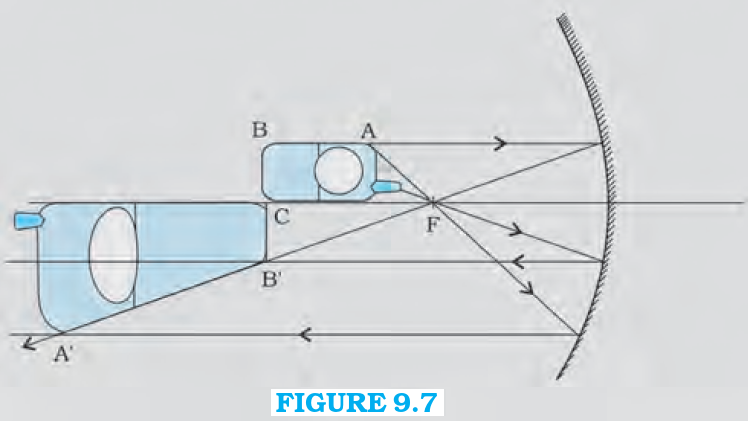
A mobile phone lies along the principal axis of a concave mirror, as shown in Fig. 9.7. Show by suitable diagram, the formation of its image. Explain why the magnification is not uniform. Will the distortion of image depend on the location of the phone with respect to the mirror?
Image
Can a photon be deflected by an electric field? By a magnetic field?
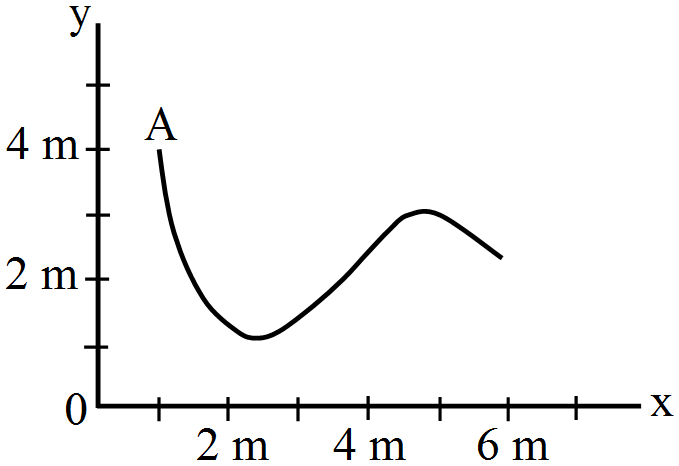
A particle starts from a point A and travels along the solid curve shown in figure. Find approximately the position B of the particle such that the average velocity between the positions A and B has the same direction as the instantaneous velocity at B.
Answer the following question:
An electron travelling west to east enters a chamber having a uniform electrostatic field in north to south direction. Specify the direction in which a uniform magnetic field should be set up to prevent the electron from deflecting from its straight line path.
If in a single slit diffraction experiment the width of the slit is doubled, what will be the effect on the central maximum?
Give two examples of intrinsic semiconductors.
What will be the values of input A and B for the Boolean expression $\big(\overline{\text{A} + \text{B}}\big) . \big(\overline{\text{A}.\text{B}}\big) = 1?$
When a p-type impurity is doped in a semiconductor, a large number of holes are created. This does not make the semiconductor charged. But when holes diffluse from the p-side to the n-side in a p-n junction, the n-side gets positively charged. Explain.
Define electric dipole moment. Write its S.I. unit.