Question
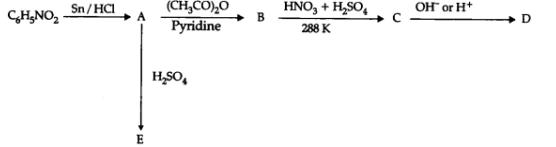
Write the structure of A, B, C, D and E in the following reactions:
Image

Answer

Get the step-by-step solution for this question inside the Vidyadip app.

Get the answer in the app

Need a full question paper?

Generate a complete, print-ready paper with questions like this in minutes — across 16+ boards, with answer keys.
Start Generating Free

Similar questions

Image
Discuss electrochemical principle regarding rusting of iron.
How will you obtain the following compounds from ethyl alcohol? Explain with equation :
(i) Diethyl ether
(ii) Iodoform
(iii) Ethyl acetate
(iv) Acetaldehyde
  1. What may be the possible oxidation states of the transition metals with the following d electronic configurations in the ground state of their atoms:
  1. $3d^34s^2, 3d^54s^2$ and $3d^6 4s^3$. Indicate relative stability of oxidation states in each case.
  2. Write steps involved in the preparation of $(i) Na_2CrO_4$ from chromite ore and $(ii) K_2MnO_4$ from pyrolusite ore.
An aromatic compound $'A\ ’$ on treatment with $\ce{CHCl_3/ KOH}$ gives two compounds $'B\ ’$ and $'C\ ’.$ Both $B$ and $C$ give the same product $'D\ ’$ when distilled with zinc dust. Oxidation of $D$ gives $E$ having molecular formula $\ce{C_7H_6O_2}.$ The sodium salt of $E$ on heating with sodalime gives $F$ which may also be obtained by distilling $A$ with zinc dust. Identify $A$ to $F.$
Explain the general characteristics of actinoids in the following terms:
(i) Physical properties
(ii) Chemical reactivity
(iii) Magnetic properties
(iv) Ionization enthalpy.
A first order reaction takes 30 min for 50% completion, what would be time for its 90% completion.
  1. Account for the following:
    1. $Mn$ shows the highest oxidation state of $+7$ with oxygen but with fluorine it shows the highest oxidation state of $+4.$
    2. $Cr^{2+}$ is a strong reducing agent.
    3. $Cu^{2+}$ salts are coloured while $Zn^{2+}$ salts are white.
  2. Complete the following equations:
    1. $2\text{MnO}_{2} + 4\text{KOH} + \text{O}_{2} \xrightarrow{\Delta}$
    2. $\text{Cr}_{2}\text{O}^{2-}_{7}+ 14\text{H}^{+} + 6\text{I}^{-}\xrightarrow{}$
  1. Give three points of difference between lanthanoids and actinoids.
  2. Give reason and select one atom$/$ion which will exhibit asked property:
  1. $Sc^{3+}$ or $Cr^{3+} ($Exhibit diamagnetic behaviour$).$
  2. $Cr$ or $Cu ($High melting and boiling point$).$
Comment on the statement that elements of the first transition series possess many properties different from those of heavier transition elements.