Question
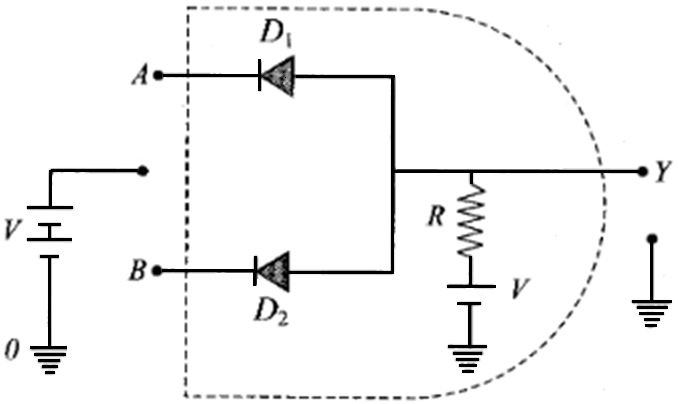
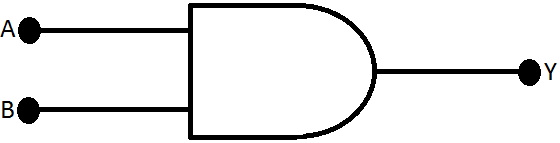
Write the truth table for the circuit shown in Fig. Name the gate that the circuit resembles.
Answer

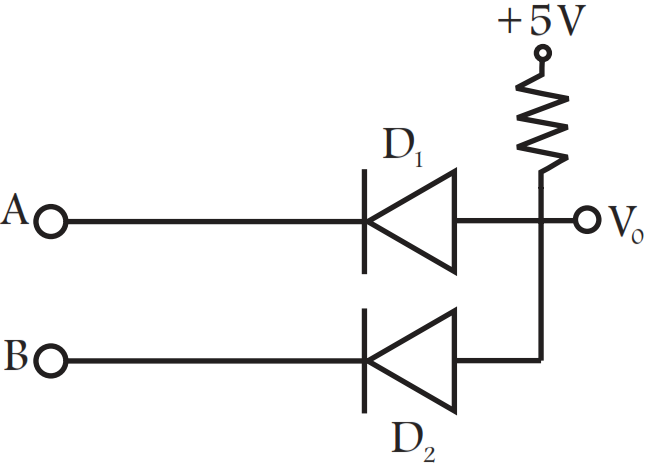
This is 'AND' Gate and its characteristics are as follows:
  1. It has tow inputs (A and B) and only one output (Y).
  1. Boolean expression is Y = A.B is read as "Y equals A AND B".
  2. Realization of AND gate
  1. A = 0, B = 0
The voltage supply throught R is forward biasing diodes $D_1$ and $D_2$ (offers low resistance), the voltage V would drop across R.
The output voltage at Y = the voltage across diode = 0.
  1. A = 0, B = 1
$D_1 =$ Conducts, $D_2 =$ Not Conducts
The out voltage at Y = The voltage across the diode $(D_1) = 0$
  1. A = 1, B = 1
$D_1 =$ Conducts, $D_2 =$ Not conducts
The out voltage at Y = The voltage across the diode $(D_2) = 0$
  1. A = 1, B = 1
None of the diode conducts
The out voltage ar Y = Battery voltage = 1
  1. Truth table for 'AND" gate
A B $V_0 = A.B$
0 0 0
0 1 0
1 0 0
1 1 1

Need a full question paper?

Generate a complete, print-ready paper with questions like this in minutes — across 16+ boards, with answer keys.
Start Generating Free

Similar questions

In a CE transistor amplifier there is a current and voltage gain associated with the circuit. In other words there is a power gain. Considering power a measure of energy, does the circuit voilate conservation of energy?
$a.$ Show that an ideal inductor does not dissipate power in an ac circuit.
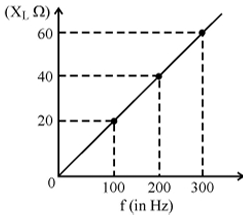
$b.$ The variation of inductive reactance $\left( X _{ L }\right)$ of an inductor with the frequency $( f )$ of the $ac$ source of $100 V$ and variable frequency is shown in the fig.
Image

$i.$ Calculate the self$-$inductance of the inductor.
$ii.$ When this inductor is used in series with a capacitor of unknown value and a resistor of $10 \Omega$ at $300 s^{-1}$, maximum power dissipation occurs in the circuit. Calculate the capacitance of the capacitor.
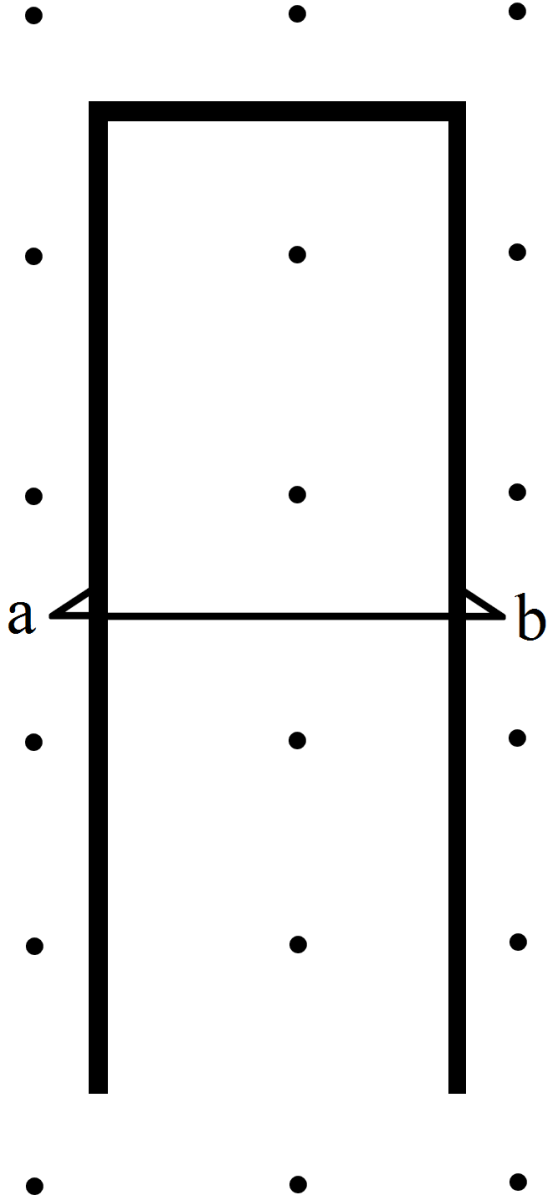
A conducting wire ab of length l, resistance r and mass m starts sliding at t = 0 down a smooth, vertical, thick pair of connected rails as shown in figure. A uniform magnetic field B exists in the space in a direction perpendicular to the plane of the rails.
  1. Write the induced emf in the loop at an instant t when the speed of the wire is v.
  2. What would be the magnitude and direction of the induced current in the wire?
  3. Find the downward acceleration of the wire at this instant.
  4. After sufficient time, the wire starts moving with a constant velocity. Find this velocity $v_m.$
  5. Find the velocity of the wire as a function of time.
  6. Find the displacement of the wire as a function of time.
  7. Show that the rate of heat developed in the wire is equal to the rate at which the gravitational potential energy is decreased after steady state is reached.
A 60W load is connected to the secondary of a transformer whose primary draws line voltage. If a current of 0.54A flows in the load, what is the current in the primary coil? Comment on the type of transformer being used.
An electron makes $3 \times 10^5$ revolutions per second in a circle of radius 0.5 angstrom. Find the magnetic field B at the centre of the circle.
Explain why elemental semiconductor cannot be used to make visible LEDs.
Analyze the force acting on a moving charge in a uniform magnetic field.###Analyze the magnetic force acting on a moving charged particle in a magnetic field. Write the magnitude of force in different conditions. Write suitable rule for finding the direction of force.
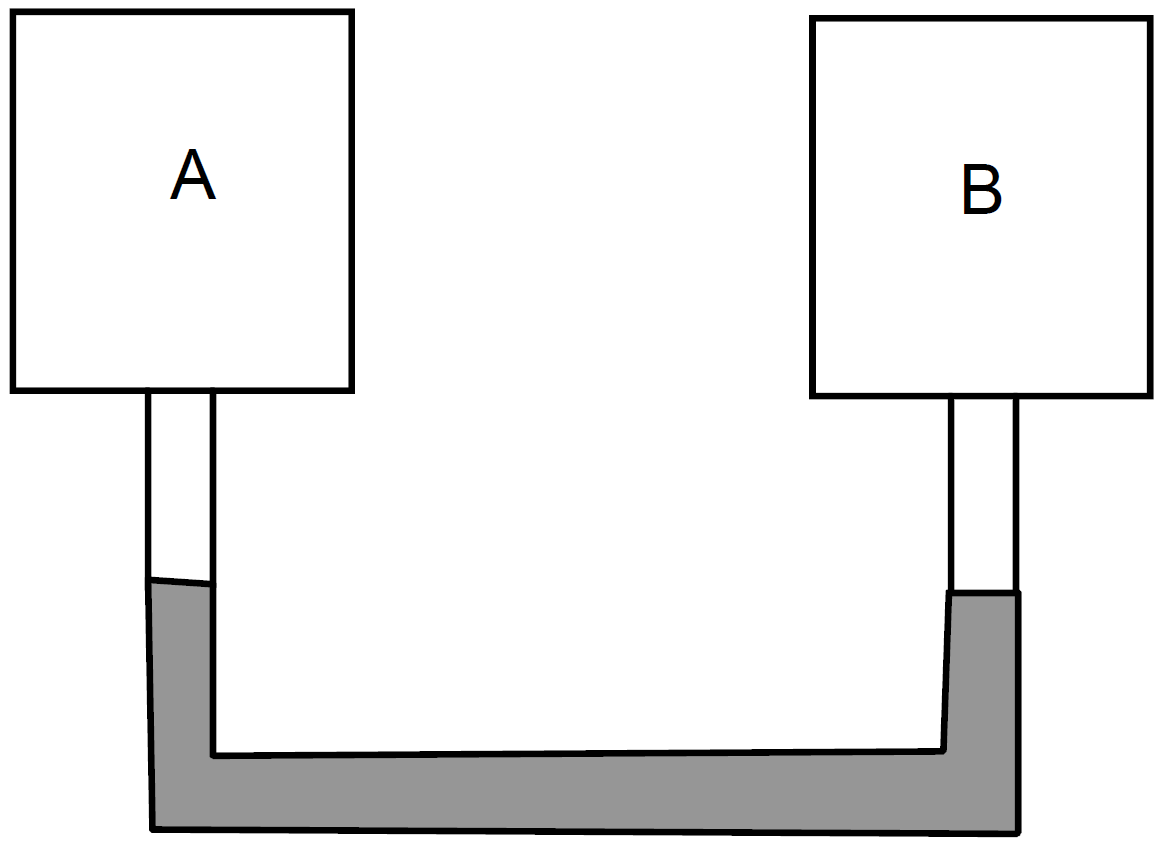
Figure shows two rigid vessels A and B, each of volume $200cm^3,$ containing an ideal gas $(C_v = 12.5JK^{-1}mol^{-1})$. The vessels are connected to a manometer tube containing mercury. The pressure in both the vessels is 75cm of mercury and the temperature is 300K.
  1. Find the number of moles of the gas in each vessel.
  2. 5.0J of heat is supplied to the gas in vessel A and 10J to the gas in vessel B. Assuming there's no appreciable transfer of heat from A to B, calculate the difference in the heights of mercury in the two sides of the manometer. Gas constant, $R = 8.3JK^{-1}mol^{-1}.$
A Cassegrain telescope uses two mirrors. Such a telescope is built with the mirrors 20 mm apart. If the radius of curvature of the large mirror is 220 mm and the small mirror is 140 mm, where will the final image of an object at infinity be?
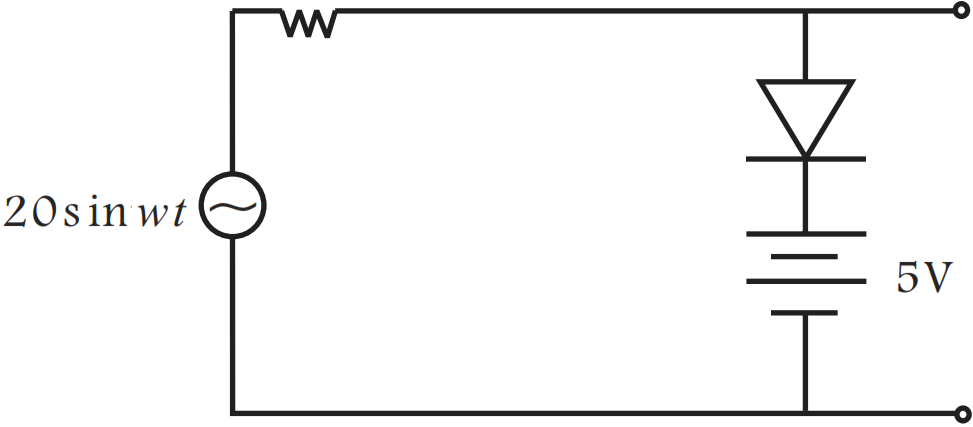
Assuming the ideal diode, draw the output waveform for the circuit given in Fig. Explain the waveform.