Question
Write the two processes that take place in the formation of a p-n junction. Explain with the help of a diagram, the formation of depletion region and barrier potential in a p-n junction.

Answer


Due to the diffusion of electrons and holes across the junction a region of (immobile) positive charge is created on the n-side and a region of (immobile) negative charge is created on the p-side, near the junction; this is called depletion region.
Barrier potential is formed due to loss of electrons from n-region and gain of electrons by p-region. Its polarity is such that it opposes the movement of charge carriers across the junction.

Need a full question paper?

Generate a complete, print-ready paper with questions like this in minutes — across 16+ boards, with answer keys.
Start Generating Free

Similar questions

Explain how the electron was historically discovered.
The electric field in a region is given by $\overrightarrow{\text{E}}=\frac{3}{5}\text{E}_0\overrightarrow{\text{i}}+\frac{4}{5}\text{E}_0\overrightarrow{\text{j}}$ with $\text{E}_0=2.0\times10^3\text{NC}^{-1}.$ Find the flux of this field through a rectangular surface of area $0.2m^2$ parallel to the $y-z$ plane.
Explain the behaviour of non polar molecule and polar molecule in uniform electric field.
  1. What is linearly polarized light? Describe briefly using a diagram how sunlight is polarised.
  2. Unpolarised light is incident on a polaroid. How would the intensity of transmitted light change when the polaroid is rotated?
A block of 2kg is suspended from the ceiling through a massless spring of spring constant k = 100N/m. What is the elongation of the spring? If another 1kg is added to the block, what would be the further elongation?
Draw a schematic arrangement for winding of primary and secondary coils in a transformer with the two coils on separate limbs of the core. State its underlying principle and find the relation between the primary and secondary voltages in terms of the number of turns of the primary and secondary windings. How are the currents in the primary and secondary coils related to the voltages in the case of an ideal transformer?
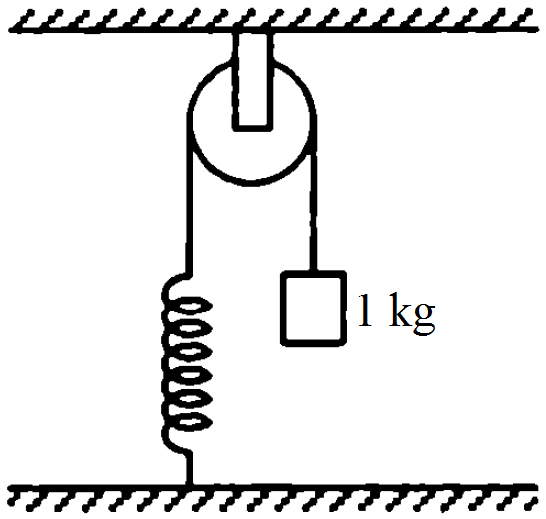
The pulley shown in figure has a radius of $20\ cm$ and moment of inertia $0.2\ kg-m^2.$ The string going over it is attached at one end to a vertical spring of spring constant $50N/m$ fixed from below, and supports a $1\ kg$ mass at the other end. The system is released from rest with the spring at its natural length. Find the speed of the block when it has descended through $10\ cm.$ Take $g = 10m/s^2.$​​​​​​​
A resistor of 100 $\Omega$ and a capacitor of $100 / \pi\mu\text{F}$ are connected in series to a 220 V, 50 Hz a.c. supply.
  1. Calculate the current in the circuit.
  2. Calculate the (rms) voltage across the resistor and the capacitor. Do you find the algebraic sum of these voltages more than the source voltage? If yes, how do you resolve the paradox?
What are the advantages of the null$-$point method in a Wheatstone bridge? What additional measurements would be required to calculate $R_{unknown}$ by any other method?
The half$-$life of $^{14}_6\text{C}$ is $5700$ years. What does it mean? Two radioactive nuclei $X$ and $Y$ initially contain an equal number of atoms. Their half$-$lives are $1$ hour and $2$ hours respectively. Calculate the ratio of their rates of disintegration after two hours.