Question
Explain how the electron was historically discovered.

Answer


Image
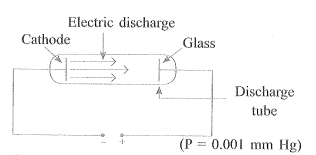
→0.001 mm Hg pressure (a pressure equal to a column of mercury 0.001 mm high) is applied to the discharge tube. Now applying a sufficient electric field between the two electrodes produces an electric discharge in the tube.
→A fluorescent glow is produced on the glass opposite to cathode.
→The colour of glow of the lamp depends on the type of glass, for example a yellowish-green colour appears on soda glass.
→The reason of this fluorescence was attributed to the radiation which comes from the cathode, called cathode rays. It was discovered by William Crookes.
→He suggested that cathode rays are made up of fast moving negatively charged particles.
• J. J. Thomson's work
→J. J. Thomson calculated the particle speed and specific charge (charge to mass ratio) $\frac{e}{m}$ of these cathode ray by applying mutually perpendicular electric and magnetic fields to the discharge tube.
→According to this calculation the speed of these particles is 0.1 to 0.2 times the speed of light in vacuum and the value of $\frac{e}{m}$ is $1.76 \times 10^{11} \frac{ C }{ kg }$.
→The value of $\frac{e}{m}$ does not depend on the metal/ material used as the cathode or on the gas contained in the discharge tube.
→When some metals irradiated by ultraviolet light, they emitted negatively charged particles having less speeds. In addition when some metals heated to a high temperature also produce similar particles.
→The particles produced in each of these cases have the same value of $\frac{e}{m}\left(1.76 \times 10^{11} \frac{ C }{ kg }\right)$.
→Thus, J. J. Thomson stated that the particles produced in each of these events are fundamental (elementry) particles, which he named electrons.

Need a full question paper?

Generate a complete, print-ready paper with questions like this in minutes — across 16+ boards, with answer keys.
Start Generating Free

Similar questions

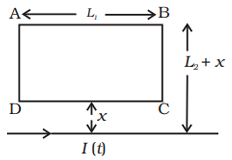
A rectangular loop of wire $\text {ABCD}$ is kept close to an infinitely long wire carrying a current $I ( t )= l _0\left(1-\frac{t}{T}\right)$ for $0 \leq t \leq T$ and $I (0)=0$ for $t > T \ ($Figure$)$. Find the total charge passing through a given point in the loop, in time $T$ .
The resistance of the loop is $R$.
Image
Two wires A and B of the same material and having same length, have their cross sectional areas in the ratio 1 : 6. What would be the ratio of heat produced in these wires when same voltage is applied across each?
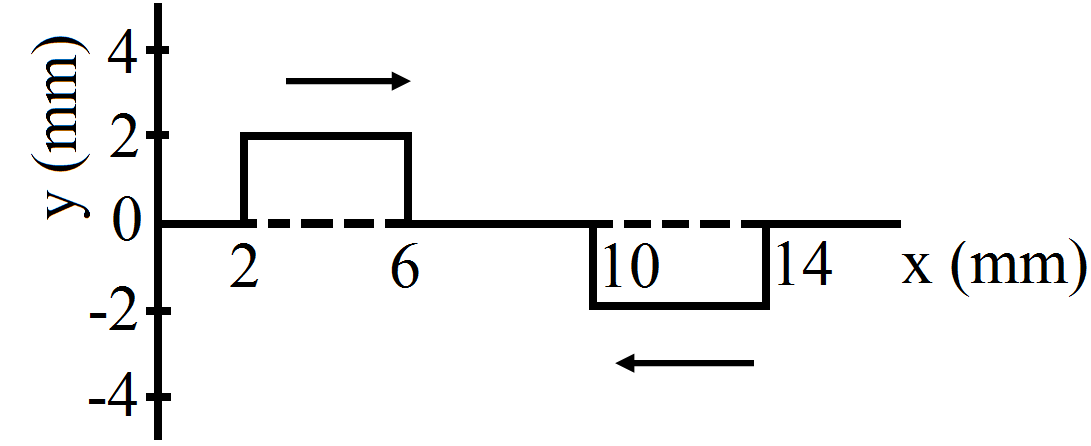
Figure shows two wave pulses at $t = 0$ travelling on a string in opposite directions with the same

wave speed $50\ cm/s$. Sketch the shape of the string at $t = 4\ ms, 6ms, 8\ ms,$ and $12\ ms.$
  1. When an AC source is connected to an ideal capacitor, show that the average power supplied by the source over a complete cycle is zero.
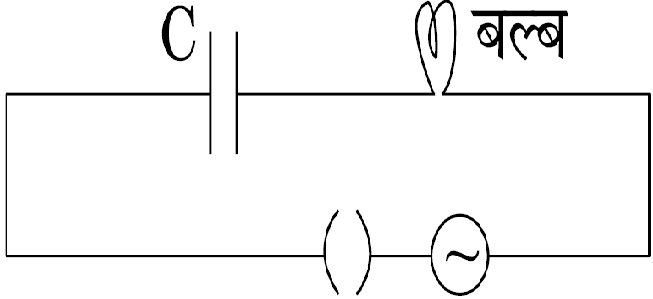
  2. A bulb is connected in series with a variable capacitor and an A.C. source as shown. What happens to the brightness of the bulb when the key is the capacitor is gradually reduced?
The horn of a car emits sound with a dominant frequency of 2400Hz. What will be the apparent dominant frequency heard by a person standing on the road in front of the car if the car is approaching at 18.0km/h? Speed of sound in air = 340m/s.
The magnetic field in a plane electromagnetic wave is given by $\text{B}=(200\mu\text{T})\sin\Big[\big(4.0\times10^{15}\text{s}^{-1}\big)\Big(\text{t}-\frac{\text{x}}{\text{c}}\Big)\Big]$ Find the maximum electric field and the average energy density corresponding to the electric field.
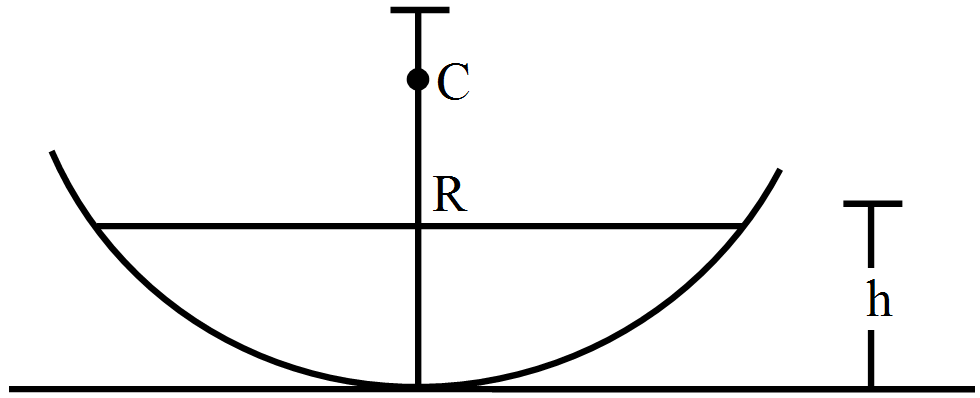
A concave mirror of radius R is kept on a horizontal. Water $\big($refractive index $=\mu\big)$ is poured into it upto a height h. Where should an object be placed so that its image is formed on itself?
Give brief explanation of a semi-conductor diode.
Draw a schematic arrangement for winding of primary and secondary coils in a transformer with the two coils on separate limbs of the core. State its underlying principle and find the relation between the primary and secondary voltages in terms of the number of turns of the primary and secondary windings. How are the currents in the primary and secondary coils related to the voltages in the case of an ideal transformer?
Area of a parallel plate capacitor is A and distance between them is $d$. It is charged with a constant current of I. An element of area $\frac{A}{2}$ is kept in the middle of the plates, parallel to the plates. What is the current flowing through this area?