Question
Write two points of difference between intrinsic and extrinsic semiconductors.

Answer

Intrinsic Extrinsic
i. Pure semiconductor. i. Doped or impure.
ii. 𝑛𝑒 = 𝑛ℎ. ii. 𝑛𝑒 ≠ 𝑛ℎ.
iii. Low conductivity at room temperature. iii. Higher conductivity at room temperature.
iv. Conductivity depends on temperature. iv. Conductivity does not dependm significantly on temperature.

Need a full question paper?

Generate a complete, print-ready paper with questions like this in minutes — across 16+ boards, with answer keys.
Start Generating Free

Similar questions

Define threshold frequency. How does it relate with the work function of the metal?
Write the expression for the resistivity of the conductor and explain each term of the expression.
The changes in a function y and the independent dy variable x are related as $\frac{\text{dy}}{\text{dx}}=\text{x}^2.$ Find y as a function of x.
What is the power dissipated by an ideal inductor in ac circuit? Explain.
A force F is applied on a block of mass M. The block is displaced through a distance d in the direction of the force. What is the work done by the force on the block? Does the internal energy change because of this work?
Briefly explain the discovery of neutrons.
Consider Experiment 6.2. (a) What would you do to obtain a large deflection of the galvanometer? (b) How would you demonstrate the presence of an induced current in the absence of a galvanometer?
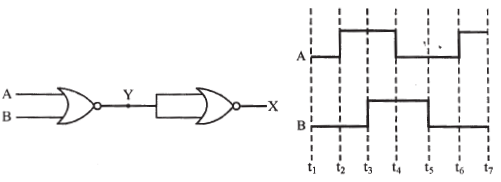
Draw the output waveform at X, using the given inputs A and B for the logic circuit shown below. Also, identify the logic operation performed by this circuit.

The speed of the yellow light in a certain liquid is 2.4 × 10⁸m/s. Find the refractive index of the liquid.
a. State Ampere's circuital law connecting the line integral of B over a closed path to the net current crossing the area bounded by the path.
b. Use Ampere's law to derive the formula for the magnetic field due to an infinitely long straight current carrying wire.
c. Explain carefully why the derivation as in (b) is not valid for magnetic field in a plane normal to a currentcarrying straight wire of finite length and passing through the midpoint of the axis.